
How to Evaluate a CNC Machine Shop Before Your First Order
Choosing a contract machining supplier without a structured evaluation is one of the most expensive mistakes a procurement or engineering team can make. You discover the problem after the first article fails, after a delivery slips three weeks, or after a PPAP submission comes back incomplete with your OEM launch date still on the calendar. Evaluating a CNC machine shop before you commit a real order takes time upfront, but it eliminates the kind of supplier failures that cost far more to fix downstream. This guide gives you a direct, practical framework for evaluating any precision machining supplier, whether you are sourcing locally in Fort Wayne, Indiana, or qualifying a new contract machining partner for a production program anywhere in the Midwest.
Table of Contents
Quick Takeaways
Key Insight | Explanation |
|---|---|
Lock down your requirements before sending any RFQ | Tolerances, material grades, inspection deliverables, and volume must be defined first. Shops cannot quote accurately without them, and you cannot compare quotes that cover different scopes. |
Ask which machines will actually run your job | A shop's brochure may list 5-axis capability, but that machine may be committed to other programs. Ask specifically which equipment will be used on your parts. |
Certifications must match your industry requirements | ISO 9001 covers most industrial work. AS9100D is required for flight hardware. A2LA accreditation validates measurement competence separately from the QMS. Verify scope statements, not just logos. |
Request a sample First Article Inspection report before committing | The format and completeness of a real FAI report tells you more about a shop's quality discipline than any sales conversation. |
A quote with no questions is a red flag | A shop that prices a complex part without asking a single question about tolerances or material has not actually reviewed your drawing. That price will change. |
PPAP documentation capability signals production readiness | Shops that routinely produce complete PPAP packages, including capability studies and material certifications, are built for production demands, not just prototype work. |
Run a small trial order before committing production volume | A trial order validates actual lead times, communication quality, and part conformance before you expose a full production program to an unproven supplier. |
Define Your Requirements Before You Search
Every failed supplier relationship starts the same way: the buyer sends an RFQ before they have fully defined what they need. Before you contact a single machine shop, you need three things locked down. First, your exact material and grade, because common materials like 6061-T6 aluminum and 304 stainless are available almost everywhere, while Inconel, titanium alloys, and engineering polymers like PEEK narrow the qualified supplier pool immediately. Second, your tolerance requirements, including which features on your drawing are critical and which are general. Third, your inspection deliverables, meaning whether you need a basic in-process check, a full First Article Inspection Report with CMM data, or a complete PPAP package.
If you send the same RFQ to five shops with these variables undefined, you will get five quotes that cover five completely different scopes of work. Two quotes can legitimately differ by two to three times in price when one includes CMM reports and material certifications and another does not. That disparity tells you nothing about which shop is better. It only tells you the quotes are incomparable.
Also decide upfront which certifications are mandatory for your application and which are preferred. Aerospace flight hardware needs AS9100D. Medical device supply chains typically require ISO 13485. Automotive Tier 1 and Tier 2 work will require PPAP documentation and often expect suppliers whose measurement systems are independently accredited. Defining these requirements before your search lets you filter the candidate pool quickly, before you invest time evaluating shops that cannot qualify for your work regardless of their machining skill.

Machine Capabilities: What Actually Matters
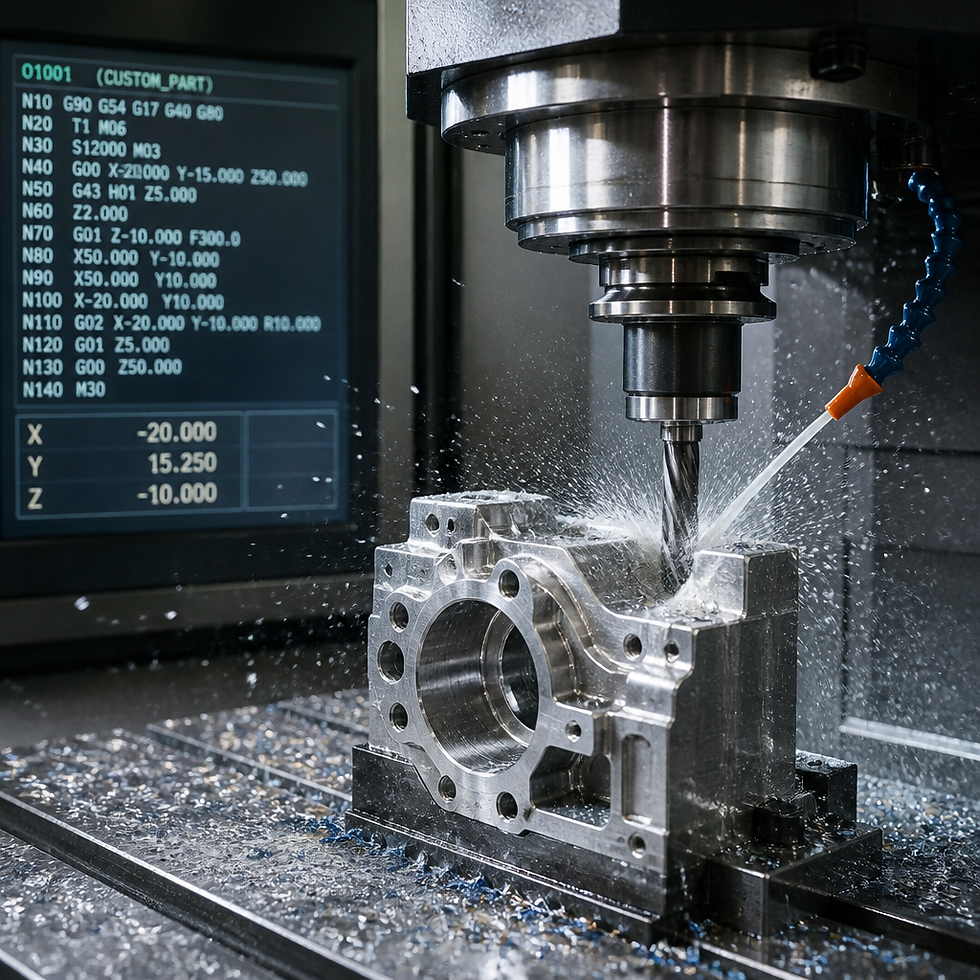
A shop's website will list every machine on the floor. What the website will not tell you is which machines are actually available for your job, in what condition they are, and whether the operators running them have experience with your material and geometry. The only way to get real answers is to ask directly.
Ask for the Machine List, Then Ask a Follow-Up Question
When a shop tells you they have 5-axis CNC milling capability, the follow-up question is: "Which specific machines will run our job?" A shop with one 5-axis machine that is fully committed to an existing long-term contract cannot actually support your program in the timeframe you need, even though their capability statement is technically accurate. The same logic applies to wire EDM, lathe machining, and any specialized process you require.
True 5-axis capability matters for complex geometry because it allows a part to be fixtured once and machined from multiple angles in a single setup. This reduces cumulative fixturing error and shortens cycle time on components with compound angles, deep pockets, or intersecting bores. A shop running primarily 3-axis vertical machining centers can complete much of the same work, but it will require more setups, more handling, and tighter process control to hold the same tolerances. For simple prismatic parts, that is a perfectly reasonable trade-off. For complex aerospace or automotive components, it is often not.
Equipment Condition Is as Important as Equipment Type
Old or poorly maintained CNC machines develop thermal drift and spindle wear that cause dimensional variation across a production run. A shop with ten machines, eight of which are past their service life, is a riskier supplier than a shop with four well-maintained, recently calibrated machines. Ask how frequently their equipment is calibrated and whether they can provide calibration records. Good shops track this because it directly affects their ability to hold tolerance repeatability across a production run, not just on the first article.
Pro tip: When evaluating machining capability for a part with GD&T callouts, ask the shop specifically whether their CMM programs are written to your drawing's geometric tolerancing scheme or to a generalized inspection routine. The answer tells you immediately whether their inspection process will catch the features that actually matter on your part.
Quality Systems and Certifications
Certifications are not proof of quality. They are proof that a third party audited the shop's quality management system against a defined standard on a specific date. That distinction matters. A shop can hold a valid ISO 9001 certificate at the organizational level while your parts run at a facility or workcell that is outside the certificate's scope. Always ask to see the actual certificate, confirm the scope statement on page one, and check the expiry date.
Understanding the Difference Between QMS Certification and Measurement Accreditation
ISO 9001 and its industry-specific variants, AS9100D for aerospace and ISO 13485 for medical devices, address a shop's quality management system as a whole. They cover process control, documentation, corrective action, and supplier management. A2LA accreditation under ISO/IEC 17025 is a different and complementary credential. It specifically validates the competence of a laboratory's measurement and testing activities, including calibration traceability, measurement uncertainty, and inspector qualifications. A shop that holds both has had its manufacturing QMS and its measurement systems independently audited. For buyers requiring tight-tolerance parts with traceable inspection data, that combination is meaningful.
The right question is not "are you certified?" but "which certificate governs the process my parts will actually run through?"
Shops that can only say they are "working toward" certification or that certification is "coming soon" are a risk. A written quality system is either in place or it is not. The absence of a formal QMS does not mean a shop does bad work, but it does mean there is no independent verification of how they control their processes, and that matters when you are qualifying a production supplier.
Inspection Capability: The Real Differentiator
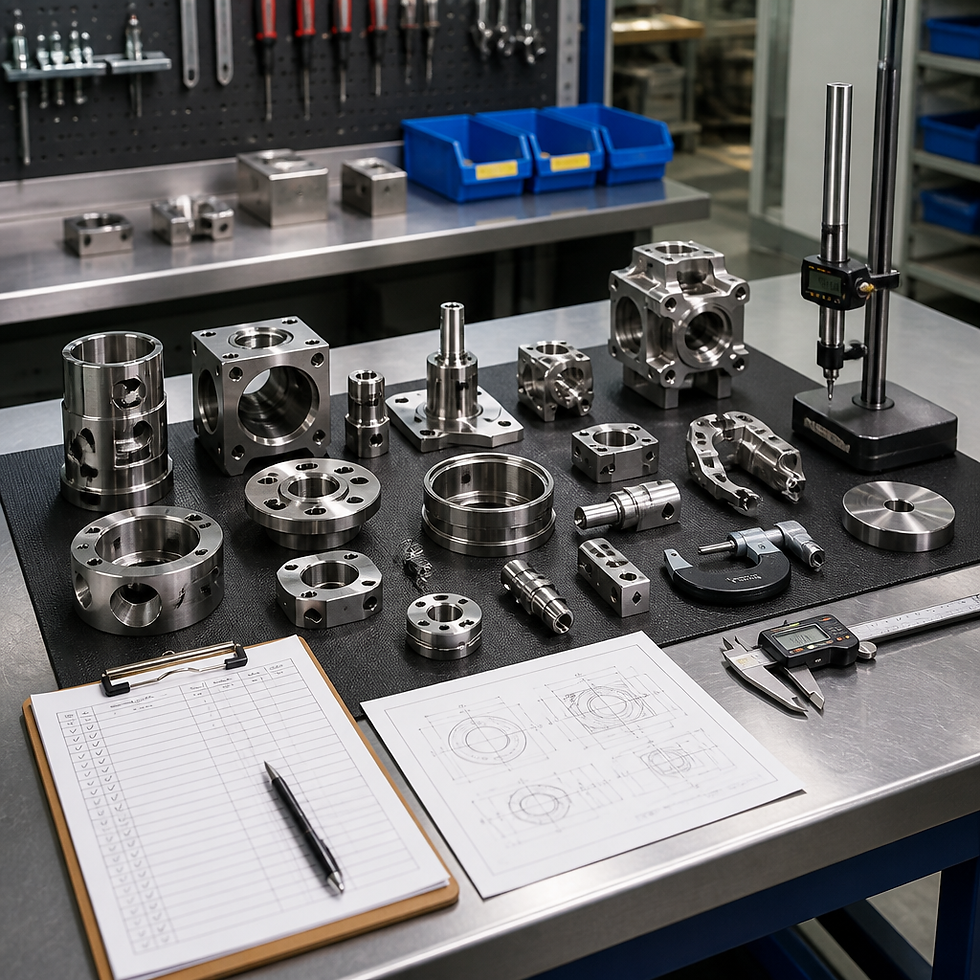
Machining skill gets a part close to nominal. Inspection capability is what confirms it got there, and what generates the documentation your customers and quality systems will require. For production tooling and critical components, a shop's inspection infrastructure matters as much as their machine list.
What In-House Inspection Equipment to Ask About
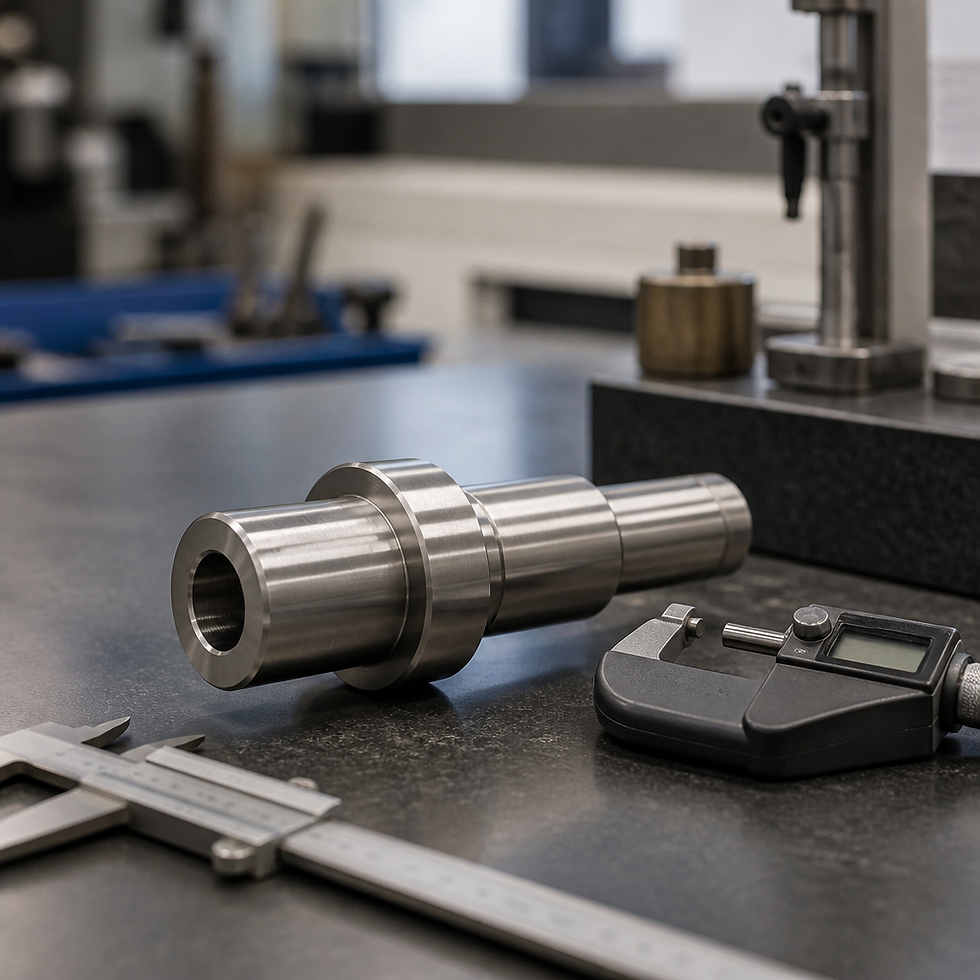
Ask specifically what inspection equipment the shop owns and operates in-house. Relevant equipment includes Coordinate Measuring Machines (CMMs) with the make, model, and resolution; optical comparators; surface roughness measurement; and any application-specific gauges relevant to your parts. In-house CMM capability means the shop can verify dimensional conformance against your drawing, generate traceable inspection data, and produce First Article Inspection Reports without outsourcing that work to a third party. Shops that outsource all inspection cannot respond quickly to non-conformance events, and their inspection data is only as reliable as their third-party's calibration and scope.
Pro tip: Before your first order, request a sample First Article Inspection report, a real one with actual measured values next to the print nominal and tolerance for each ballooned dimension. The format, completeness, and clarity of that document reveals more about the shop's quality discipline than any certification letter.
PPAP Documentation as a Reliability Signal
For automotive and other production supply chain applications, the ability to produce complete PPAP documentation, including dimensional results, material certifications, process capability studies, and MSA data, is a clear signal that a shop is built for production demands. Shops that produce PPAP routinely have quality systems designed to support ongoing production monitoring, not just first-part approval. A shop that hesitates when asked about PPAP or is unfamiliar with the elements of the process is almost certainly not ready to support an automotive Tier 1 or Tier 2 program.
How to Read an RFQ Response
How a shop responds to your RFQ before you place an order tells you almost everything about how they will behave after you place one. The quality of the RFQ response is a proxy for the quality of their engineering communication, their process discipline, and their customer service model.
What a Good RFQ Response Looks Like
A strong RFQ response does at least three things. It asks clarifying questions about your drawing, specifically about tolerances, material certification requirements, and surface finish expectations. It provides a clear breakdown of what is and is not included in the quoted price, particularly around secondary operations, finishing, and inspection deliverables. And it gives you a realistic lead time with an explanation of what drives that timeline.
A shop that quotes a complex part in under an hour with no questions has not reviewed your drawing. That quote will change, either when they discover a feature they missed or when a scope item you assumed was included turns out not to be. Bait-and-switch pricing, where an artificially low initial number is followed by upcharges for standard deburring, material certifications, or basic packaging, is a well-known problem in the lower tier of the contract machining market. It is avoidable if you read the initial response carefully and ask explicitly what is included.
Communication Speed and Consistency
Note how quickly and clearly the shop responds before you become a customer. Slow, vague pre-sale communication reliably gets worse after they have your purchase order. Identify your main point of contact and confirm that the same person or team will manage your account through production, not just through the quoting process. Supplier relationships where the contact changes frequently are a documented risk factor for quality and delivery problems.
Red Flags That Disqualify a Shop
Most supplier problems are predictable. The signals are visible during the evaluation if you know what to look for. Any single item below is worth serious scrutiny. Multiple items together are disqualifying.
Quoting without reviewing your drawing. If a shop gives you a price without asking a single clarifying question, they are estimating, not quoting. That price will change.
Refusing a shop tour. Established shops with well-maintained floors and controlled processes are willing to show them. Reluctance to allow a visit is a signal worth taking seriously.
No quality certifications and no explanation. Uncertified shops can do good work. But the absence of any third-party audit means you have no independent verification of how they control their processes.
A price significantly below every other quote. If one quote is substantially cheaper than all others for the same scope, the low bidder is cutting something. Material certification, inspection, finishing, or all three.
Vague answers about material origin or refusal to provide mill certifications. For any production application, material traceability is not optional. A shop that is vague about where stock comes from cannot support your traceability requirements.
No references from comparable work. An established shop that cannot name customers in similar industries or provide references has either no relevant experience or unhappy customers. Both are problems.
No in-house inspection capability. A shop with no CMM and no willingness to share First Article data is not equipped to verify their own conformance in any rigorous way.
Running a Trial Order
No amount of pre-qualification work substitutes for an actual production trial. Send a small-batch order of real production parts, not a simplified proxy. The trial needs to stress the same processes, materials, and tolerances your production program will require. Anything less gives you false confidence.
Evaluate three things on the trial order. First, dimensional conformance, meaning verify that parts meet your drawing requirements on every critical dimension, not just a spot check. Second, documentation completeness, meaning confirm that the FAI report, material certifications, and any other required quality records are complete, accurate, and delivered on time. Third, communication behavior across the order lifecycle. Did they notify you proactively of any issues? Did they deliver on the committed lead time? Was the invoice consistent with the quote? Problems on any of these three fronts during a low-stakes trial order will repeat at scale during production.
One underused evaluation step is sending the same part drawing to two or three candidate shops simultaneously. The comparison across quoting quality, response time, and trial order results gives you a reliable ranking that is hard to dispute internally. For high-volume programs or long-term supply relationships, that comparison effort pays for itself quickly.
Comparing Evaluation Approaches
Evaluation Approach | What It Validates | Key Limitation |
|---|---|---|
Website and certification review only | General capability claims, listed equipment, and whether certifications are current | Does not confirm certificate scope, actual equipment availability, or real inspection depth for your specific parts |
RFQ and response analysis | Engineering communication quality, quoting discipline, and whether the shop actually reviewed your drawing | Does not confirm physical part quality or whether committed lead times are achievable |
Trial order with full inspection and documentation review | Actual dimensional conformance, documentation completeness, real lead time performance, and communication under production conditions | Requires time and a real parts investment, but this cost is small compared to a failed production launch |
The only complete evaluation uses all three approaches in sequence. Website review narrows the pool. RFQ analysis refines it further. A trial order confirms the final selection. Skipping the trial order is the single most common shortcut that procurement teams regret.
Frequently Asked Questions
What certifications should I require from a CNC machine shop before placing a production order?
It depends on your industry and customer requirements. ISO 9001 is the baseline for most industrial and general manufacturing work. AS9100D is required for aerospace flight hardware. ISO 13485 is required for medical device supply chains. If the shop performs inspection and calibration services, A2LA accreditation under ISO/IEC 17025 validates their measurement system competence separately from the QMS. Always request the actual certificate, not just a logo, and verify the scope statement matches the work you are sourcing.
How do I evaluate a CNC machine shop's quality without visiting in person?
Request a sample First Article Inspection report, one with real measured values against actual drawing callouts, not a blank template. Ask for a list of their inspection equipment including CMM make, model, and resolution. Request material certifications from a previous or sample order. How they respond to these requests, both the quality of the documents and the speed of delivery, tells you a great deal about their quality discipline without requiring a site visit. That said, a shop visit remains the most reliable single evaluation tool for qualifying a long-term production supplier.
What should be included in an RFQ I send to a contract machining supplier?
Your RFQ should include your finished part drawing with all GD&T callouts and tolerances, the exact material and grade required, the quantity for the initial order and any expected production volumes, your required inspection deliverables (basic dimensional check, FAI, PPAP, or CMM report), any finishing or surface treatment requirements, required certifications, and your target delivery date. Sending a complete, consistent RFQ to every candidate shop is what makes the responses comparable. Incomplete RFQs produce incomparable quotes.
How important is 5-axis CNC capability when evaluating a machine shop?
For parts with compound angles, intersecting features, deep pockets, or complex contoured surfaces, 5-axis capability is often the difference between a shop that can hold your tolerances reliably and one that cannot. True 5-axis milling allows complex geometry to be machined in a single setup, eliminating the cumulative error introduced by repositioning a part across multiple setups on a 3-axis machine. For simpler prismatic parts, 3-axis machining with live tooling on a lathe may be perfectly sufficient. The key question is not whether the shop has 5-axis capability but whether the capability matches your specific geometry.
What does PPAP documentation tell me about a contract machining supplier?
Production Part Approval Process (PPAP) documentation, including dimensional results, material certifications, process capability studies, and measurement system analysis, tells you that a supplier is built for production monitoring, not just prototype or first-article approval. A shop that produces PPAP routinely has quality infrastructure designed to detect and respond to process drift across production runs, not just verify the first part off the machine. For automotive and other regulated supply chain applications, the ability to deliver a complete PPAP package is a minimum qualification, not a differentiator.
Is it reasonable to ask for a shop tour before placing a first order?
Completely reasonable and worth doing for any significant program. Good shops with well-maintained equipment and controlled processes are generally willing to show them. A shop tour lets you see whether equipment appears maintained, whether the floor is organized and clean, whether there are in-process inspection stations, and whether work-in-progress is labeled and traceable. Shops that decline or deflect tour requests without a good explanation warrant a more skeptical evaluation. For a cleanroom or calibration-sensitive environment, ask about controlled area access policies specifically.
What is the single biggest mistake buyers make when evaluating a new CNC machine shop?
Skipping the trial order and going directly to production volume. Qualification paperwork and a strong RFQ response are necessary but not sufficient. The only way to know whether a shop will perform on real parts under real production conditions is to run a small batch of actual production-intent parts, inspect them fully against your drawing, and review every piece of documentation they deliver. A trial order that reveals a problem early costs far less than discovering the same problem after a full production release.
Have you developed an evaluation process for qualifying precision machining suppliers that has saved your team from a supplier failure? Share your experience in the comments.
References
Ten key factors for evaluating and choosing a reliable CNC machining supplier
Buyer's checklist for what to look for in a CNC machine shop before ordering
Step-by-step buyer decision framework for choosing a CNC machine shop
Twelve factors to check when comparing CNC machining quotes from suppliers
How to choose a CNC machining supplier including red flags and questions to ask

Comments