
Contract Manufacturing Success Through Better Communication
When a precision machining project fails, poor communication is almost always the root cause. A client sends incomplete prints, the machine shop makes assumptions about tolerances, and what should have been a straightforward job becomes a costly rework cycle. According to a 2023 study by Deloitte, 70% of manufacturing project delays stem from inadequate information exchange between buyer and supplier. The difference between a machining partner who delivers on time and one who creates problems often has nothing to do with equipment capability. It comes down to how well you communicate requirements, changes, and expectations.
Table of Contents
Quick Takeaways
Key Insight
Explanation
Complete CAD files prevent 80% of revision cycles
Providing native CAD formats with GD&T callouts eliminates interpretation errors that plague PDF-only submissions
Single point of contact reduces turnaround time by 35%
Designating one technical liaison on each side streamlines decision-making and prevents conflicting direction
Pre-project meetings cut machining errors in half
A 30-minute discussion about critical features, material concerns, and tolerance priorities before work starts eliminates costly assumptions
Written change orders are non-negotiable
Verbal modifications to prints or specifications create liability nightmares and quality failures, documented changes create accountability
Inspection requirements must be specified upfront
Waiting until delivery to request PPAP documentation or first article inspection reports creates delays and added costs
Regular status updates prevent schedule surprises
Weekly progress reports on multi-week projects catch problems while there is still time to adjust
Material certification saves time and money
Specifying exact material grades and certification requirements at quote stage prevents procurement delays
Establishing Clear Specifications From First Contact
The quality of your initial request for quote directly determines project success. A machine shop cannot provide an accurate quote or timeline without complete information, yet most RFQs arrive with missing details that force assumptions.
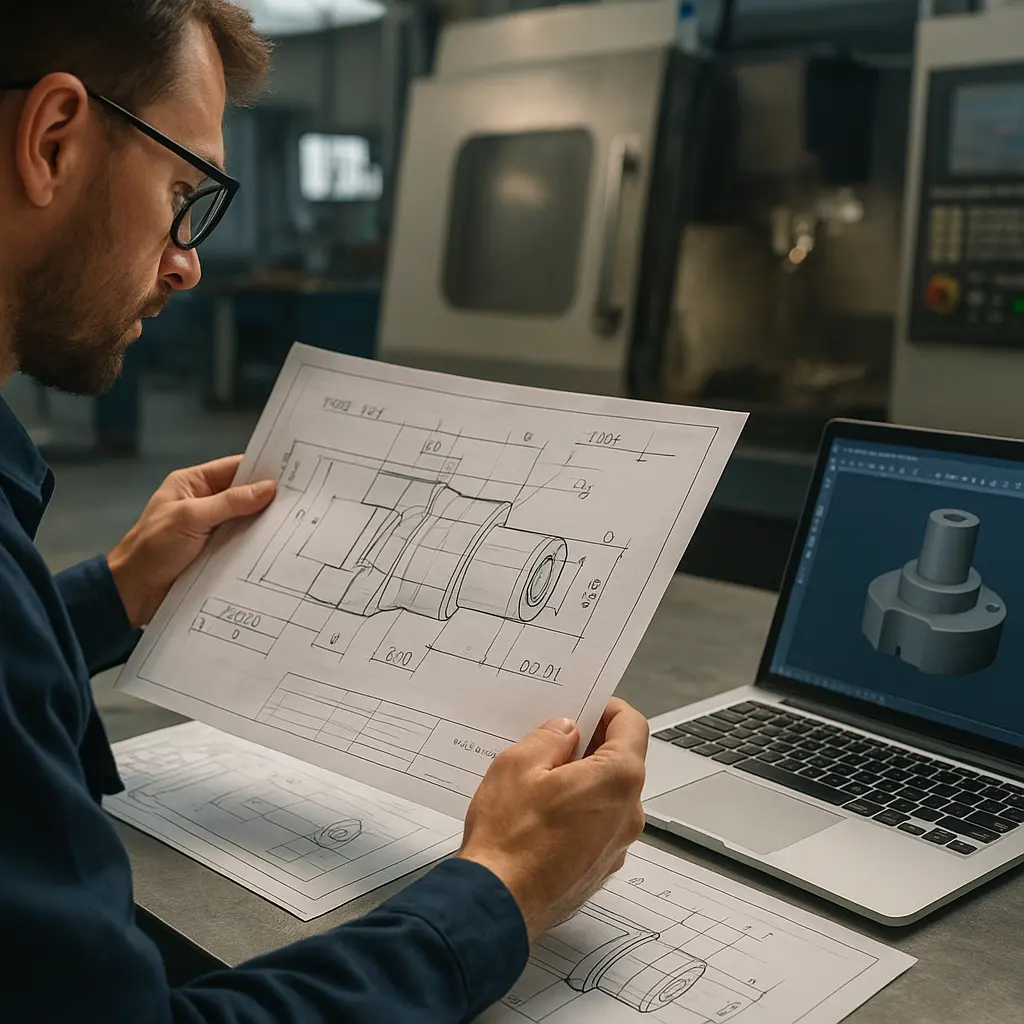
When contacting a precision machining partner like SCPM, include native CAD files in STEP or IGES format, not just PDFs. The 3D model allows the programmer to evaluate tooling access, fixture requirements, and potential interference issues before quoting. A PDF drawing forces manual interpretation that introduces errors.
Pro tip: Include a revision history table directly on your engineering drawings. It creates a clear record of what changed and when, preventing confusion when older print versions circulate.
Material specifications must be explicit. Stating "aluminum" is insufficient when 6061-T6, 7075-T651, and 2024-T3 have vastly different machining characteristics and costs. Specify the exact alloy, temper, and any required certifications like mill test reports or material certs.
Defining Tolerances That Match Your Actual Needs
Over-tolerancing is expensive and unnecessary. A common mistake is applying ±0.001" to every dimension when only critical mating surfaces require that precision. Standard machining tolerances of ±0.005" or ±0.010" work perfectly for non-critical features and reduce both cost and lead time.
In practice, a part with ten features toleranced to ±0.001" costs 40-60% more to produce than the same part with only two critical dimensions at that tolerance. The machine shop must employ slower feeds, take lighter cuts, and perform additional inspection steps for every tight tolerance called out.
Geometric dimensioning and tolerancing (GD&T) eliminates ambiguity better than coordinate dimensioning. A positional tolerance callout with datum references communicates design intent far more clearly than stacked bilateral tolerances that leave interpretation to the machinist.
Documentation Standards That Prevent Mistakes
Consistent documentation practices separate professional organizations from those that constantly fight fires. Every contract manufacturing project needs a structured information package that travels with the job from quote through final inspection.
The minimum documentation set includes complete engineering drawings with all views and sections needed for manufacturing, 3D CAD models in a neutral format, material specifications with grade and certification requirements, finish and coating requirements with specific standards referenced, quantity requirements for both prototype and production runs, and delivery timeline expectations.
A purchase order that references the quote number, part number, revision level, and quantity prevents mix-ups when multiple projects run simultaneously. This sounds basic, but incomplete POs cause 30% of production delays according to industry data.
Version Control That Actually Works
Machining from an obsolete print revision is one of the most common and costly errors in contract manufacturing. Implement a revision control system where every drawing includes a revision letter or number in a consistent location, a date of last revision, and a description of what changed.
When sending updated drawings, explicitly state in the transmittal email: "Revision B supersedes Revision A. Changes include: relocated mounting hole per ECN 12345." Never assume the machine shop will notice subtle changes by comparing files.
"Effective supplier communication in manufacturing reduces defect rates by up to 50% compared to projects with poor information exchange." - MIT Supply Chain Management Study, 2022
Pro tip: Use a project-specific folder naming convention that includes part number, revision level, and date. "PN-12345_RevB_2024-01-15" leaves no ambiguity about which files are current.
Managing Design Changes and Revisions
Engineering changes during production are inevitable, but how you communicate those changes determines whether they create minor adjustments or major crises. A verbal phone call saying "make that hole a bit bigger" is a recipe for scrap parts and finger-pointing.
Every design change requires a formal engineering change notice (ECN) or engineering change order (ECO) that documents what is changing, why it is changing, which revision level implements the change, and who approved it. This creates a traceable record that protects both parties.

When a change affects parts already in production, specify exactly what to do with work in progress. Options include scrap and restart, complete current run then implement change, or rework completed parts if feasible. The machine shop cannot make that decision unilaterally.
Change Request Response Times
Manufacturing facilities like SCPM with 5-axis CNC milling and wire EDM capabilities can often accommodate design changes quickly, but they need adequate notice. A change request submitted after machining has started may require scrapping partially completed work.
The data consistently shows that changes communicated before 25% completion of the production run add 10-15% to timeline and cost. Changes after 75% completion can double costs due to scrapped work and programming time.
Build change request windows into your project timeline. If you know design validation is still underway, communicate that to your machining partner so they can schedule the work accordingly rather than starting immediately.
Quality Expectations and Inspection Protocols
Quality problems almost always trace back to misaligned expectations about inspection and acceptance criteria. The time to discuss inspection requirements is during the quoting phase, not when parts arrive and fail your incoming inspection.
Specify whether you require first article inspection reports (FAIR), production part approval process (PPAP) documentation, certificate of conformance, material certifications, dimensional inspection reports with actual measurements, or surface finish verification. These documentation requirements directly affect cost and timeline.
A precision manufacturer with A2LA accreditation like SCPM can provide calibrated inspection data that meets aerospace and automotive standards, but those services cost more than basic visual inspection. Be clear about what level of documentation your application genuinely requires.
Critical Characteristics Identification
Not every dimension on a drawing carries equal importance. Identify critical characteristics that directly affect form, fit, or function and communicate them clearly. Many manufacturers use a special symbol or note on the drawing to flag critical features requiring 100% inspection versus sampling.
For parts requiring CMM inspection, provide the measurement points and frequency in advance. A shop with CMM programming capability can build inspection routines in parallel with machining programs, reducing turnaround time.
Inspection Approach
Best Use Case
Communication Requirements
First Article Inspection
New part introduction, design validation, critical aerospace/automotive components
Specify FAIR format (AS9102 or equivalent), identify critical characteristics, provide acceptance criteria for each dimension
Production Sampling
Established parts with stable processes, moderate risk applications
Define sample size and frequency, specify which features require measurement, establish control chart limits
Certificate of Conformance
Commercial applications with supplier quality agreement in place
Establish what conformance statement covers, define retention requirements for backup data
Delivery Schedules and Realistic Timelines
Unrealistic delivery expectations damage supplier relationships and ultimately hurt your business. A precision machine shop can only compress timelines so much before quality suffers or they have to decline the work entirely.
Lead times depend on several factors outside the machining shop's control, including material availability, fixture and tooling design time, programming complexity, and current shop load. A simple 2-axis lathe part might turn in three days while a complex 5-axis milled component requires three weeks.
When you genuinely have a rush requirement, communicate the business reason and ask what is possible rather than demanding an arbitrary date. Most shops will accommodate legitimate emergencies, but they cannot do it for every job without premium charges.
Building in Contingency Time
A common mistake is treating the machine shop's quoted lead time as the delivery date when building your project schedule. That leaves zero margin for material delays, design changes, or inspection issues. Add 15-20% contingency to supplier lead times in your master schedule.
For parts requiring secondary operations like plating, coating, or heat treat, coordinate timing with your machining partner. These external processes add one to three weeks and require scheduling coordination to prevent delays.
Progress Reporting Frequency
For projects extending beyond two weeks, establish weekly progress check-ins. A brief status email covering work completed, current stage, any issues identified, and confirmation of on-time delivery prevents surprises.
The most effective progress reports include specific milestones: "Material received and inspected," "Programming complete," "First article machined and inspected," "Production run 50% complete." This gives you visibility to catch problems early.
Technology Tools for Better Supplier Communication
The right communication tools streamline information exchange and create searchable records that prevent "he said, she said" disputes. Email remains the standard for formal communication because it creates dated, written records of all exchanges.
However, email alone becomes unwieldy for complex projects with multiple stakeholders. A shared project folder in Dropbox, Google Drive, or similar cloud storage where both parties access current drawings, inspection reports, and project documents eliminates version confusion.
For real-time technical discussions, a quick phone call or video conference solves problems faster than ten back-and-forth emails. The key is documenting the outcome of those conversations with a follow-up email summarizing what was decided.
CAD Collaboration Platforms
Modern CAD systems like SolidWorks, Fusion 360, and Siemens NX offer cloud collaboration features where suppliers can view, comment on, and measure 3D models without needing the full software license. This speeds up design reviews and reduces misinterpretation.
When using these tools, establish clear protocols about who can make changes versus who has view-only access. The last thing you want is a supplier inadvertently modifying your master model.
Automated Status Updates
Some larger machine shops implement manufacturing execution systems (MES) that provide automated status updates as jobs move through production stages. This reduces manual communication overhead while keeping customers informed.
For smaller shops without MES, a shared spreadsheet tracking active projects with columns for current status, completion percentage, and next milestone creates transparency without requiring daily phone calls.
Frequently Asked Questions
What information should I include in an initial RFQ to a precision machine shop?
Include complete 3D CAD files in neutral format, 2D drawings with all dimensions and tolerances, specific material requirements with grade and certification needs, quantity for both prototype and production, required delivery timeline, and any special inspection or documentation requirements like PPAP or first article inspection. The more complete your RFQ, the more accurate the quote and timeline.
How do I prevent mistakes when engineering changes occur mid-production?
Implement a formal engineering change order process that documents what is changing, why it is changing, which revision level implements the change, and written approval from authorized personnel. Never communicate changes verbally. Specify exactly what should happen to work already in progress, whether scrap and restart, complete current run then change, or rework if possible.
What is the difference between PPAP documentation and a certificate of conformance?
PPAP (Production Part Approval Process) is a comprehensive documentation package required by automotive customers that includes dimensional inspection results, material certifications, process flow diagrams, and capability studies. A certificate of conformance is a simpler statement that parts meet drawing requirements, typically without supporting measurement data. PPAP takes longer and costs more but provides much greater traceability.
How often should I request progress updates on a multi-week machining project?
For projects extending beyond two weeks, weekly status updates strike the right balance between staying informed and not creating excessive administrative burden. Updates should include specific milestones completed, current stage of work, any issues identified, and confirmation that delivery remains on schedule. Daily updates are unnecessary unless problems arise.
Should I send PDF drawings or native CAD files to my machining supplier?
Send both whenever possible. Native CAD files in STEP or IGES format allow the machine shop to import geometry directly into CAM software, reducing programming errors and time. PDFs or printed drawings serve as the official dimensional reference with tolerances and notes. The combination of 3D model for manufacturing and 2D drawing for inspection provides the clearest communication.
What are critical characteristics and why do they matter for supplier communication?
Critical characteristics are dimensions or features that directly affect part function, safety, or assembly. Identifying these on your drawings with special symbols or notes tells the machine shop which features require 100% inspection versus sampling. This focuses quality efforts where they matter most while avoiding unnecessary inspection cost on non-critical features, typically reducing overall inspection time by 30-40%.
How do I handle rush orders without damaging my relationship with my machining partner?
Be honest about whether it is a genuine emergency or poor planning on your end. Explain the business reason for the rush and ask what is realistically possible rather than demanding an arbitrary date. Understand that rush work requires premium pricing to cover overtime or displaced work. Reserve rush requests for true emergencies so your supplier takes them seriously when they occur.
What communication practices have made the biggest difference in your contract manufacturing projects? Share your experience in the comments.


Comments