
What to Include in a Precision Machining RFQ
- carystraley
- 4 hours ago
- 12 min read
A poorly written precision machining RFQ wastes everyone's time. Shops either have to chase you down for missing details, build in risk margins that inflate pricing, or decline to quote entirely. In practice, the difference between a quote returned in 24 hours and one that stalls for a week usually comes down to what the buyer included when they submitted the request. This guide covers every element a precision machining shop like Summit City Precision Machining needs to turn your request into an accurate, actionable quote fast.
Table of Contents
Quick Takeaways
Key Insight
Explanation
Always include a revision-controlled drawing
Quoting from a sketch or verbal description forces the shop to assume tolerances, which inflates price and creates liability for both sides.
Specify material by alloy and condition, not just by name
Saying "aluminum" is not enough. 6061-T6, 7075-T651, and 2024-T3 machine differently, cost differently, and suit different applications.
State your tightest tolerance explicitly
If a single feature requires +/- 0.0001", the shop needs to know upfront. That feature may require dedicated fixturing or a specific machine, which changes the quote entirely.
Include quantity breaks when possible
Requesting pricing at 10, 50, and 250 pieces gives you cost visibility for scaling and helps the shop optimize setup amortization in their bid.
List PPAP or FAI requirements at the start
PPAP Level 3 documentation and first article inspection reports require dedicated engineering time. Discovering this after a quote is accepted causes scope disputes.
Identify the end-use industry or application
Aerospace and automotive parts may require specific material certifications, traceability, or process approvals that a shop needs to account for in pricing.
Confirm acceptable file formats before sending
Most shops can accept STEP, IGES, and PDF. Sending a proprietary CAD format without confirmation adds unnecessary back-and-forth before quoting even begins.
Why RFQ Quality Directly Affects Price and Lead Time
A machining shop cannot quote what it cannot fully define. When critical information is missing from a request for quote machining submission, estimators have two choices: add contingency cost to cover uncertainty, or contact the buyer to fill in the gaps. Both options slow the process and typically result in a higher price than a complete RFQ would have generated.
The data consistently shows that incomplete RFQs are among the top reasons quotes take longer than buyers expect. A well-structured RFQ is not just paperwork. It is a signal that you understand the manufacturing process, which builds trust with a shop and often results in more competitive pricing because the estimator does not need to pad for unknowns.
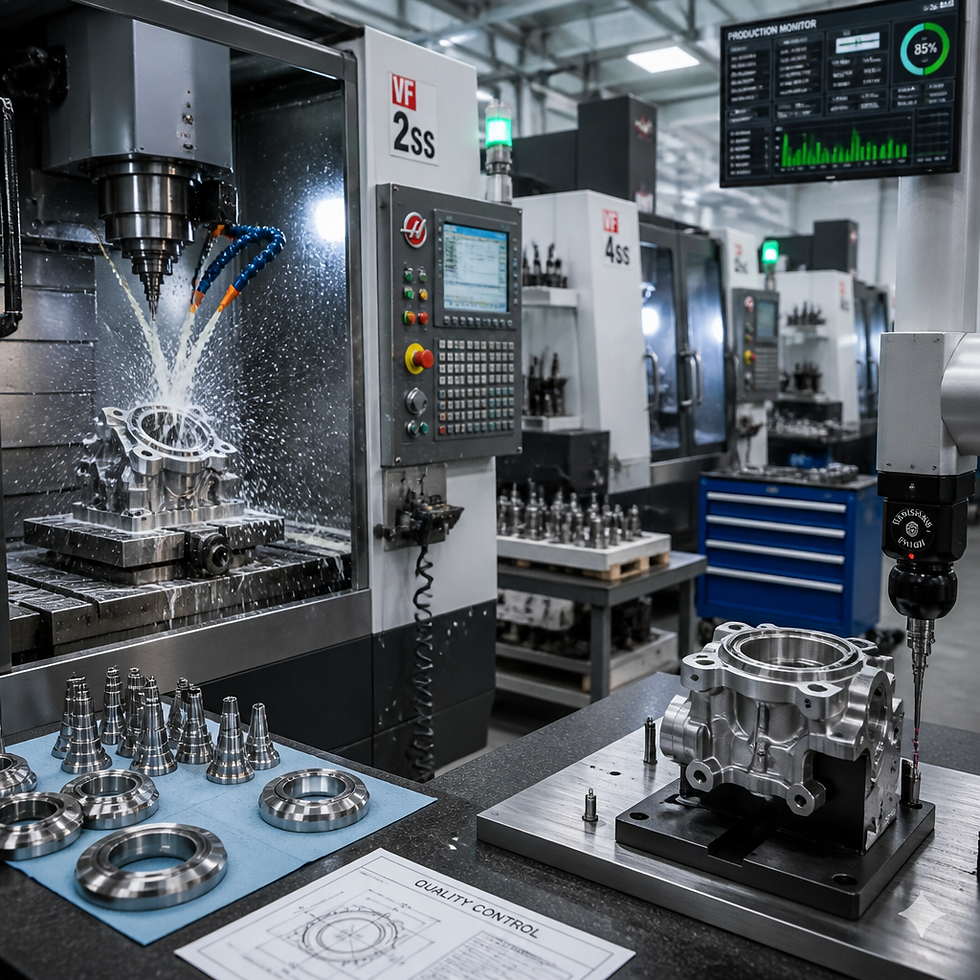
At Summit City Precision Machining, which serves industrial customers across Fort Wayne and beyond with capabilities including 5-axis CNC milling, wire EDM, and CMM-based inspection, an RFQ that includes complete drawings, material callouts, tolerance requirements, and quality expectations can be turned around significantly faster than one missing even one of those elements. The goal of this guide is to help you build that complete package the first time.

Technical Drawing and CAD File Requirements
The drawing is the foundation of any precision machining RFQ. Without it, the shop is guessing at geometry, feature relationships, and critical dimensions. A common mistake is sending only a 3D model file without an accompanying 2D drawing. The 3D model defines shape. The 2D drawing defines what matters most from a manufacturing standpoint, including tolerances, datums, surface finish, and inspection callouts.
What your drawing package should include
Your drawing should carry a title block with part number, revision level, material, and drawing scale. Each view should be fully dimensioned with tolerances called out either in a general tolerance block or directly on individual features. GD&T callouts should use proper ASME Y14.5 symbology if your part has form, orientation, or position requirements that a linear tolerance cannot adequately capture.
For 3D model files, STEP (.stp) or IGES (.igs) formats are universally readable and should be included alongside your PDF drawing. Native format files from SolidWorks, CATIA, or Siemens NX are acceptable at many shops, but confirm compatibility first. Sending a STEP file with a dimensioned PDF eliminates ambiguity about model intent versus drawing intent when the two do not match.
Revision control matters more than buyers think
Always include the revision letter or number on every file you send. If you send a Rev B drawing but the model file is still at Rev A, the shop may program from the wrong geometry. That mistake gets discovered during inspection and costs both parties time and money. A simple consistent naming convention like "PartNumber_RevB.stp" and "PartNumber_RevB.pdf" eliminates the ambiguity.
Pro tip: If you have a legacy part with no formal drawing, invest in having the drawing created before submitting the RFQ. Shops can sometimes create drawings from samples, but they will charge for that time and the resulting drawing is still your responsibility to approve before production begins.
Material Specifications and Certifications
Material specification is one of the most frequently underspecified elements in a request for quote machining submission. Stating the alloy and temper is the minimum. Depending on your application, you may also need to specify whether material certifications are required, what standard the certifications must meet, and whether the material must come from a domestic or approved source.
Alloy, temper, and condition
For aluminum, the difference between 6061-T6 and 7075-T651 is not just price. Machinability, strength, corrosion resistance, and anodizing response differ meaningfully between them. For steel, specifying 4140 pre-hard versus 4140 annealed affects both the machining approach and the post-machining heat treatment plan. Give the shop the full material designation from the start.
Material certifications and traceability
If your industry requires material certifications, such as a mill cert with chemical and physical properties, state that in the RFQ. Automotive and aerospace customers frequently require full material traceability, meaning the shop must maintain records linking each part back to a specific material heat or lot number. That requirement adds cost and administrative overhead. It should be disclosed upfront, not after the quote is accepted.
SCPM's A2LA-accredited MetroLab division handles calibration and inspection documentation, which means material traceability and certification management are already part of the workflow for qualifying customers. But the shop still needs to know the requirement exists before pricing the job.
"The most expensive purchase order is the one with undefined requirements. Every ambiguity in a manufacturing specification becomes a negotiation after the fact." Manufacturing Engineering Magazine, SME Publications
Tolerances, GD&T, and Surface Finish Callouts
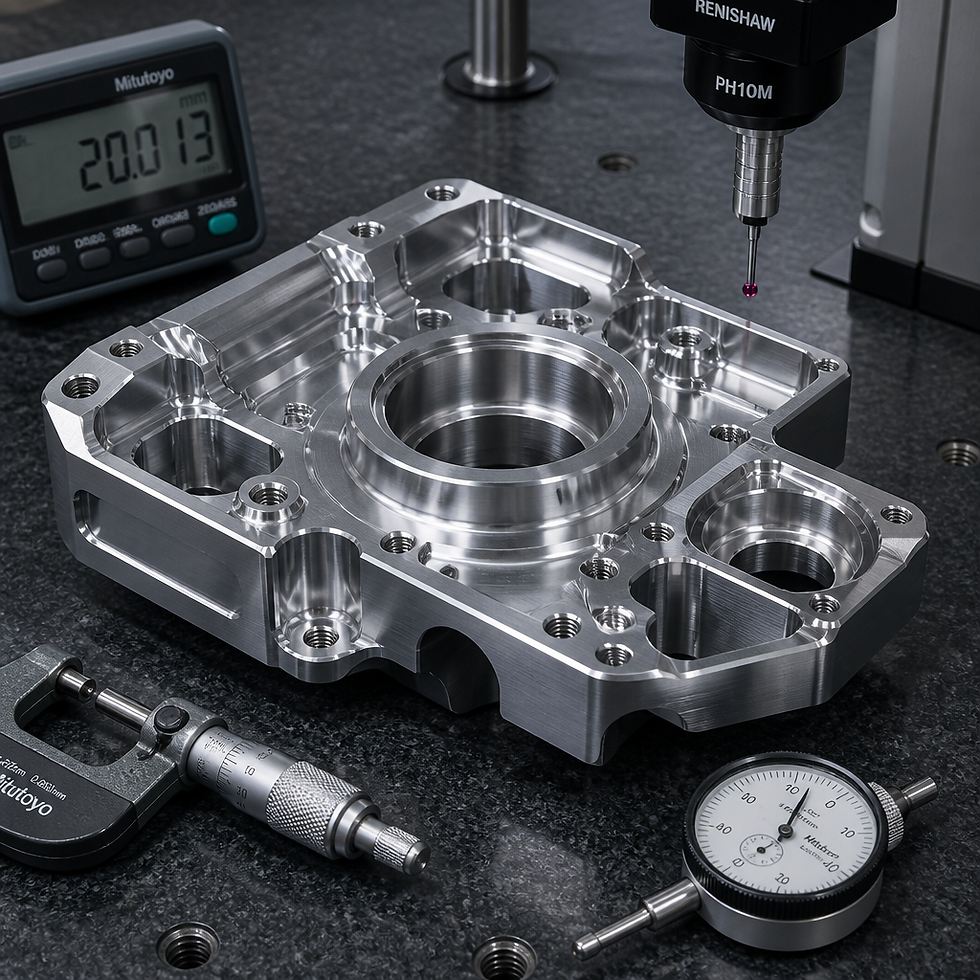
Tolerance requirements drive machine selection, fixturing complexity, inspection method, and cycle time. A part with all features toleranced to +/- 0.005" is a different manufacturing proposition than one with a bore requiring +0.0000" / -0.0002". Both of those parts might look similar on paper, but the latter may require grinding, honing, or a dedicated CMM inspection step that changes the price by a factor of two or more.
State your tightest tolerance explicitly in the RFQ body
Do not make the estimator hunt through a complex drawing to find the critical dimension. In the body of your RFQ email or form, explicitly state the tightest tolerance required on the job. Something like "critical bore tolerance is +0.0000" / -0.0002" per Drawing Rev C" tells the estimator immediately what they are dealing with. This single habit reduces quoting errors and speeds response time.
Surface finish requirements
Surface finish callouts should use standard Ra values in microinches or micrometers, not descriptive terms like "smooth" or "mirror finish." A 32 Ra machined finish, a 16 Ra ground finish, and a 4 Ra lapped finish require entirely different processes and inspection methods. If your part has both functional and cosmetic surfaces, call them out separately on the drawing and flag them in the RFQ.
If post-machining treatments like anodizing, plating, heat treatment, or coating are required, include them in the RFQ and note whether the tolerances shown are pre-treatment or post-treatment. Anodizing adds material to a surface. Hard chrome adds significant build. If the tolerance is a post-treatment dimension, the shop needs to machine to a different target to hit the finished dimension.
Quantity, Delivery Expectations, and Scheduling
Quantity affects setup amortization, material procurement lead time, and sometimes machine selection. A single prototype part might run on a different machine or with a different fixturing approach than a production run of 500. When you include quantity breaks in your RFQ, typically prototype, small production, and volume production quantities, you give the shop the ability to optimize their approach for each tier and give yourself actionable pricing data for planning purposes.
Be realistic about required delivery dates
Stating "ASAP" as a delivery requirement is not useful to a shop trying to schedule capacity. Stating "need 10 pieces within 3 weeks of purchase order" is actionable. If you have a hard deadline driven by a downstream assembly or customer commitment, say so. Shops like SCPM serving Fort Wayne industrial customers can often accommodate expedited timelines, but they need to know the constraint exists to plan accordingly.
Also specify whether the delivery date applies to all pieces or the first shipment of a staggered delivery. For production runs, partial deliveries can sometimes start within a shorter timeframe than the full quantity. If that flexibility matters to your project, say so in the RFQ.
Pro tip: If you are sourcing a part for the first time and do not have a hard delivery date yet, say "prototypes needed within 4 weeks, production quantities to be determined." This gives the shop the context to quote appropriately without locking you into a production commitment prematurely.
Inspection and Quality Documentation Requirements
Quality documentation requirements can add 10 to 30 percent to part cost depending on depth and complexity. This is not a complaint about the requirements. It is a reality that buyers sometimes discover after a quote is accepted, which causes budget and timeline problems. The solution is simple: disclose all quality requirements in the original RFQ.
PPAP, FAI, and dimensional reports
If you require a Production Part Approval Process (PPAP) submission, specify the level. PPAP Level 1 requires only a Part Submission Warrant. PPAP Level 3 requires a full package including dimensional results, material certifications, process flow, control plan, FMEA, and appearance approval. These are fundamentally different scopes of work and cost differently.
First Article Inspection (FAI) reports, also called FAIR or ballooned drawing reports with CMM data, require the shop to inspect and document every dimension on the drawing for an initial production sample. For a complex part with 80 measured dimensions, that is a half-day of CMM time plus report compilation. SCPM's CMM programming capabilities and MetroLab division are equipped to handle this, but again, the requirement must be declared at quoting time.
Certification and traceability requirements
Some customers require AS9100 or IATF 16949 certified suppliers. Others require specific process certifications for operations like welding, plating, or heat treatment. If any of these apply to your contract machining Fort Wayne sourcing needs, list them explicitly. A shop that does not hold the required certification either cannot bid or must subcontract that operation, both of which affect price and lead time.
RFQ Submission Method Comparison
There is no single correct way to submit a precision machining RFQ, but the method you use affects how quickly and accurately the shop can respond. The following comparison covers the three most common approaches used by industrial buyers today.
Submission Method
Best Use Case
Key Limitation
Email with attached PDF drawing and STEP file
Standard production and prototype parts where the buyer has a complete drawing package. Works well for established buyer-supplier relationships with clear communication channels.
Easy for files to get lost in an inbox or for version confusion if revision updates are sent later without clear file naming conventions.
Online RFQ form with file upload
New supplier relationships or first-time submissions where structured data entry ensures the buyer covers all required fields. Reduces missing information at intake.
Form fields may not accommodate complex multi-part assemblies or highly customized quality requirements. May require a follow-up call for complex jobs.
Structured RFQ document (Word or PDF template)
Complex jobs with multiple parts, multiple operations, or extensive quality requirements where a narrative format allows for context and cross-references between parts.
More preparation time required from the buyer. Requires the buyer to have an existing template or create one. Less efficient for simple single-part quotes.
Common RFQ Mistakes That Delay or Kill Quotes
After walking through what to include, it is equally useful to name what consistently goes wrong. These are the patterns that experienced estimators at precision machining shops see repeatedly, and each one costs the buyer time and sometimes money.
Sending a 3D model without a 2D drawing
A STEP file communicates shape. It does not communicate tolerances, datum structure, surface finish, or inspection requirements in a way that creates a binding manufacturing record. Some shops will quote from a model-only package by applying default tolerances, but this creates risk. If the part fails to perform, there is no agreed drawing to arbitrate what the requirement actually was. Always include a 2D drawing.
Omitting the end-use context
Knowing that a part is a structural aerospace bracket rather than a non-critical industrial fixture changes how an estimator prices risk, selects material sources, and plans inspection. A common mistake is treating the drawing as the sole communication vehicle when a single sentence of context, such as "this is a flight-critical component requiring full FAI and AS9100 source requirements," would have saved three rounds of follow-up email.
Requesting a quote without specifying finishing or assembly requirements
If your part requires thread inserts, press-fit pins, anodizing, or assembly with a mating component, those operations must be included in the RFQ. A machined price does not include finishing unless the finishing is specified. Discovering after purchase order issuance that the shop's price did not include anodizing because the RFQ did not mention it is a painful and avoidable situation.
For contract machining Fort Wayne customers working with SCPM on production tooling or custom machined components, clearly defining the complete scope from raw material through final inspection in the initial RFQ is the single most effective way to get an accurate first quote and avoid scope disputes after the job starts.
Frequently Asked Questions
What file formats should I send with a precision machining RFQ?
The most universally accepted combination is a STEP (.stp) file for 3D geometry and a PDF for the 2D dimensioned drawing. IGES is also widely supported. Native CAD formats like SolidWorks .sldprt or CATIA .CATPart can be accepted by many shops, but you should confirm compatibility before submitting to avoid delays. Always include both a 3D model and a 2D drawing. Never rely on the model alone for a production job.
Does quantity affect how I should write my RFQ?
Yes, significantly. For prototype quantities of one to five pieces, emphasize lead time requirements and whether production intent tolerances apply or if looser prototype tolerances are acceptable. For production quantities, include annual volume estimates even if the initial order is small, because shops may offer better pricing if they know recurring volume is coming. For anything over 50 pieces, requesting pricing at multiple quantity breaks gives you useful cost modeling data.
Do I need to specify PPAP requirements if I am not in the automotive industry?
PPAP documentation originated in automotive, but first article inspection reports and dimensional certifications are used across aerospace, defense, medical, and general industrial applications under different names and formats. If your customer or quality system requires documented evidence that the first production parts conform to all drawing requirements, state that clearly in your RFQ using whatever terminology your industry uses. The shop will translate it into the appropriate documentation format.
What should I include if I am sourcing a part for the first time with no existing supplier?
For a new sourcing relationship, include your full drawing package, material specification, quantity requirements, target delivery date, and a brief description of the application and any relevant industry certifications you require from suppliers. Also confirm whether the shop holds any required quality certifications such as ISO 9001, AS9100, or IATF 16949 before sending the RFQ, since a mismatch in certification requirements eliminates the shop from consideration before the quote process begins.
How detailed does the delivery requirement need to be in my RFQ?
Be specific. Include the required delivery date or lead time, whether the date applies to all pieces or first shipment, the shipping destination or whether you will arrange pickup, and whether expedited delivery is an option at a premium if the standard lead time cannot be met. Vague delivery requirements like "as soon as possible" force the shop to quote based on standard scheduling, which may not align with your actual need.
Should I include budget information in my precision machining RFQ?
Sharing a target budget or a budget range is optional, but it can be useful in two situations. First, if the part is borderline between two manufacturing approaches, knowing your budget helps the estimator recommend the approach that fits your cost constraint. Second, if your target is significantly below what the part costs to make, the shop can tell you that upfront rather than after investing time in a full quote. Providing a budget is not a negotiating weakness. It is useful information that helps both parties move efficiently.
Have you submitted an RFQ to a precision machining shop recently? We would like to hear what worked, what was missing, and whether this guide helps you structure a stronger request next time.


Comments