
Multi-Axis Machining Setup Optimization Guide
Setup time is one of the most persistent cycle time killers in precision manufacturing, and it rarely gets the attention it deserves. For shops running multi-axis machining on complex components, a poorly sequenced setup can add hours to a job that the actual cutting cycle completes in minutes. The data consistently shows that setup and changeover account for 30 to 50 percent of total non-cutting time in CNC environments. For industrial manufacturers with tight delivery windows, that is not a footnote. It is a direct hit to throughput, cost, and on-time performance.
Table of Contents
Why Setup Optimization Matters in Multi-Axis Environments

Multi-axis machining centers, whether 4-axis or full 5-axis simultaneous, represent a significant capital investment. A 5-axis machining center sitting idle during a 45-minute setup sequence is a cost center, not a production asset. The whole justification for moving to multi-axis capability is the ability to machine complex geometry in fewer operations and fewer setups. That advantage disappears the moment your setup process is disorganized.
In practice, the shops that extract the most value from their multi-axis equipment are not necessarily the ones with the newest machines. They are the ones with repeatable, documented setup processes that minimize the gap between the last good part and the first good part of the next run. Setup reduction is not just about speed. It is about predictability, which is what industrial customers and contract manufacturers actually depend on.
Quick Takeaways
Key Insight
Explanation
Consolidate operations per setup
On a 5-axis machine, machining five faces in one setup eliminates four repositioning events, directly cutting non-cutting time and reducing fixturing errors.
Standardize tooling offsets before the run
Pre-setting tools offline with a tool presetter reduces on-machine offset entry time and eliminates first-article scrap caused by incorrect tool length assumptions.
Use modular fixturing for repeat jobs
Modular fixturing systems allow setups to be replicated from a documented baseline, cutting setup time by 40 to 60 percent on recurring part numbers.
Validate programs in simulation before running
CAM simulation catches collision risks and inefficient toolpath sequences before they reach the machine, preventing costly crashes and rework cycles.
Integrate in-process probing
On-machine probing after rough cuts confirms stock condition before finishing passes, catching deviation early without sending the part to CMM mid-cycle.
Sequence cuts to minimize thermal growth errors
Running rough passes first and allowing thermal stabilization before finish cuts reduces dimensional drift, especially in tight-tolerance aerospace and automotive features.
Document every setup with photos and offset records
A written and photographed setup sheet eliminates operator interpretation differences and allows any qualified machinist to replicate the setup from scratch with no tribal knowledge.
Workholding Strategy: The First Domino
If you get the workholding wrong, nothing else in the setup process recovers it. A common mistake is designing fixturing around the first part rather than around the recurring production run. Custom soft jaws, tombstones, and dedicated fixture plates all add upfront time but return that investment many times over across a production series.
For multi-axis machining specifically, the fixturing goal is maximum feature access with minimum setups. On a 5-axis trunnion-style machine, a well-designed tombstone can present four or five workpiece faces to the spindle without the operator touching the part. That is not a luxury. It is the whole point of the machine.
Modular Versus Dedicated Fixturing
Modular systems like Jergens, Bluco, or Schunk modular plates are the right answer for job shops running diverse part families. They allow quick reconfiguration from a documented baseline, and the repeatability is measurable, typically within 0.001 inch or better at the locating features. Dedicated fixturing makes more sense for long-run production parts where setup frequency is high and the geometry never changes.
The wrong choice is cutting corners with generic vises when the part geometry demands something better. A poorly located part in a 5-axis operation does not produce a scrap part. It produces a crashed spindle and a three-week repair timeline.
Datum Selection and Repeatability
Datums drive everything in precision machining. The setup datum must align with the inspection datum or you are creating a built-in measurement error that will follow the part through every operation. In practice, this means coordinating with your quality team before the first chip is cut, not after the first article fails.
Pro tip: When designing fixtures for 5-axis work, specify datum surface finish and flatness requirements on the fixture drawing itself. A locating surface that measures 32 Ra when it should be 16 Ra will introduce repeatable positioning error on every single part in the run.
Toolpath and Program Sequencing for Cycle Time Reduction
Cycle time optimization in multi-axis machining happens in the CAM seat, not on the shop floor. By the time a program hits the controller, the cycle time is largely locked in. The decisions made during programming, tool selection, cut strategy, and operation sequencing, determine 70 to 80 percent of the final cycle time.
The most common cycle time waste in CAM programs is unnecessary repositioning moves and excessive air cutting. Modern CAM platforms like Mastercam, Hypermill, and Siemens NX offer toolpath smoothing and optimized linking moves that dramatically reduce non-cutting spindle movement. In practice, switching from standard linking to optimized high-feed linking moves on a complex aerospace pocket can cut cycle time by 15 to 25 percent with no change to the cutting parameters.
High-Feed Roughing Versus Traditional Roughing
High-feed roughing strategies, using shallow axial depth with high radial engagement and aggressive feed rates, are consistently faster than traditional pocket milling for multi-axis setups. The tool loading is lower, the heat generation is manageable, and the machine dynamics favor the approach. For shops still programming with conventional roughing strategies on 5-axis work, the cycle time penalty is real and avoidable.
Trochoidal milling and adaptive clearing strategies also reduce peak tool load, which extends tool life and reduces the frequency of tool changes during long runs. Fewer tool changes mean fewer opportunities for setup interruption and dimensional variation between tools.
Minimizing Axis Travel Between Features
On a simultaneous 5-axis machine, the rotary axis moves, specifically A and B axis repositioning, add cycle time that is invisible to operators focused only on spindle engagement. Programming features in geographic clusters rather than by tool or operation type reduces total rotary travel. This sequencing decision costs nothing in CAM time and can recover three to eight minutes per part on complex components with scattered feature patterns.
"The best time to optimize cycle time is during programming, not during the run. Every minute saved on paper is a minute saved on every part in the series." -- AMT, The Association For Manufacturing Technology, from its published best practices for CNC production planning.
Pro tip: Run a dry cycle with a ballbar or axis trace before production starts on a new 5-axis program. Abnormal axis reversals and velocity spikes in the trace reveal toolpath geometry problems that slow the machine and stress the mechanics, and they are fixable before the first part is run.
Comparison of Setup Optimization Approaches
Approach
Best Application
Typical Setup Time Reduction
Modular Fixturing (e.g., Schunk, Bluco)
Job shops with diverse part families and repeat orders; 5-axis tombstone configurations
40 to 60 percent reduction on repeat setups versus custom-built each time
Offline Tool Presetting (e.g., Zoller, Parlec)
High-mix production with frequent tool changes; shops running tight-tolerance finishing passes
15 to 25 minutes saved per setup by eliminating on-machine tool length measurement
On-Machine Probing with Renishaw or Marposs
Complex multi-step operations requiring mid-cycle dimensional verification without CMM interruption
Reduces first-article rejection rate by 60 to 80 percent, eliminating rework setups
First Article Inspection and In-Process Measurement
First article inspection is where many setup optimization gains get quietly erased. A fast setup that produces a failing first article has not saved time. It has cost the time of the setup, the time of the inspection, the time of the correction, and the time of a second setup. Getting the first part right the first time is the actual efficiency goal.
In-process probing on the machine table is the most practical tool for catching deviation before it becomes scrap. Renishaw and Marposs both offer probe cycles that can check critical features after roughing and before finishing, confirming that the part is in tolerance before committing the last 20 percent of the cycle time to finishing passes. This is not a luxury feature for aerospace shops. It is a production control tool that any shop running tight-tolerance work should use as a standard practice.
Connecting Machine-Side Probing to CMM Verification
Machine-side probing does not replace CMM inspection for final verification and PPAP documentation. The two serve different functions. On-machine probing confirms process stability during the run. CMM programming and full dimensional reporting confirm conformance to the print and satisfy customer quality requirements. For shops providing first article inspection reports and PPAP packages, the CMM data is the customer-facing deliverable. The machine-side probing is what ensures you arrive at the CMM with a part that passes.
When the machine-side probe data and the CMM data disagree consistently, the problem is almost always datum misalignment between the machine coordinate system and the inspection coordinate system. Resolving that alignment issue is a one-time fix that improves every subsequent setup in the same fixture family.
Operator Standardization and Setup Documentation
The single most underutilized tool in setup reduction is a well-written setup sheet. Shops that rely on experienced operators to carry setup knowledge in their heads have not optimized their setup process. They have outsourced their setup consistency to individual memory, which is not a process. It is a risk.
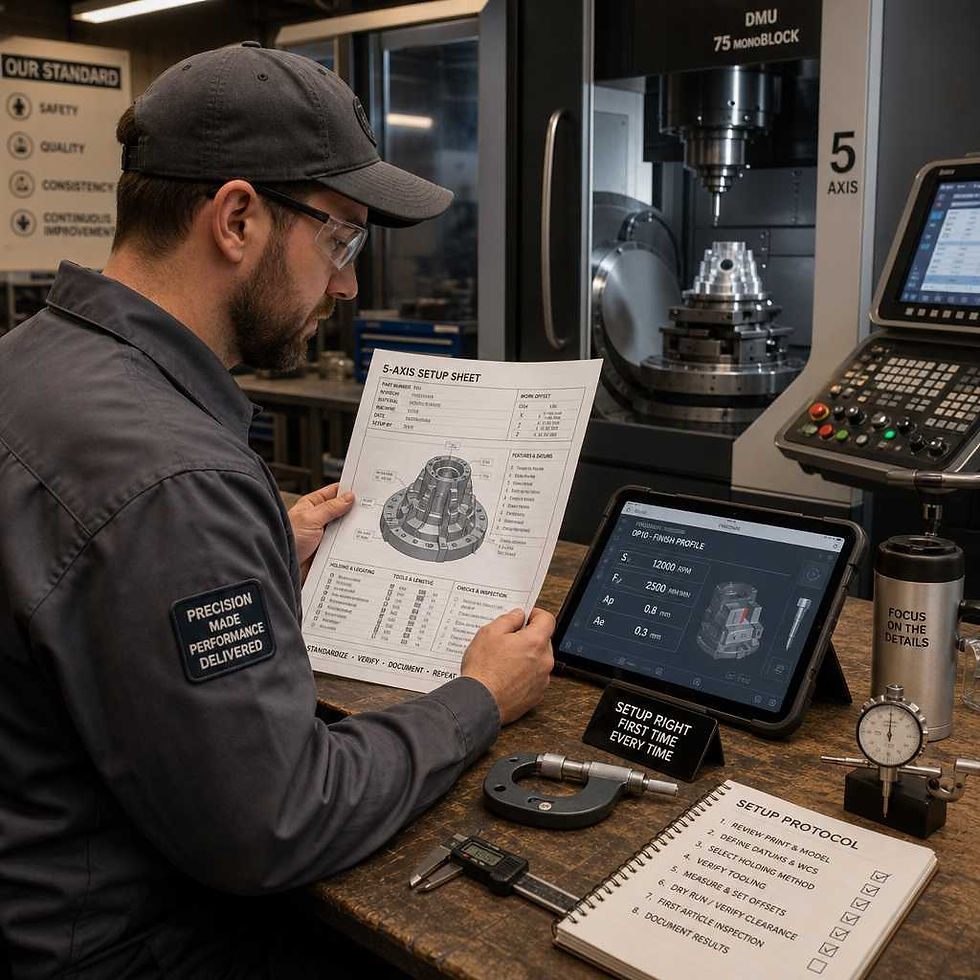
A complete setup sheet for multi-axis work includes fixture mounting instructions with torque values, datum probe positions and expected readings, tool list with presetter values for each tool, offset table baseline values, and a photograph of the completed setup as a visual reference. This document means any qualified operator can replicate the setup without asking anyone. That is what makes repeat jobs faster on the third run than the first, and it is what prevents a 15-minute setup from taking 45 minutes when the regular operator is absent.
SMED Principles Applied to CNC Setup
Single-Minute Exchange of Die methodology, originally developed for stamping and press operations, translates directly to CNC setup reduction. The core discipline is separating internal setup tasks, those that require the machine to be stopped, from external setup tasks, those that can be done while the machine is running the previous job. Tool preparation, fixture staging, offset table verification, and program loading are all external tasks. Running them on the previous part's cycle time means the machine stops only for the physical changeover, not for all the preparatory work that surrounded it.
The data consistently shows that shops implementing SMED principles on their CNC cells reduce total setup time by 30 to 50 percent in the first 90 days. The improvement does not require new equipment. It requires a documented process and the discipline to follow it.
Frequently Asked Questions
What is the biggest source of wasted time in a multi-axis machining setup?
The biggest source is unplanned interruptions caused by missing information, including absent offset values, incomplete tool lists, and undocumented datum positions. These are not skill problems. They are documentation problems. A complete setup package eliminates the vast majority of setup delays that operators experience on unfamiliar jobs.
How much cycle time can be saved by switching from 3-axis to 5-axis machining on complex parts?
For parts with features on multiple faces, the shift from 3-axis to 5-axis machining typically reduces total cycle time by 30 to 50 percent by eliminating intermediate setups. The actual number depends on part geometry, but any component that requires more than two setups on a 3-axis machine is a candidate for meaningful cycle time reduction on 5-axis equipment.
Does faster cycle time always mean lower quality in precision machining?
No, and this is one of the most persistent misconceptions in the industry. Cycle time optimization through better toolpaths, modular fixturing, and in-process probing consistently improves quality by reducing the number of setups, repositioning events, and operator interventions, all of which are sources of variation. Speed that comes from cutting feeds or skipping inspection steps does compromise quality. Speed that comes from process optimization does not.
What CAM software features most directly reduce cycle time in 5-axis programming?
Adaptive clearing strategies, optimized high-feed linking moves, rest machining passes that update stock awareness between operations, and collision-aware toolpath smoothing all produce measurable cycle time reductions. Mastercam's Dynamic Motion and Hypermill's 5-axis tangent machining strategies are specific examples that consistently outperform legacy toolpath strategies on complex geometry.
How does PPAP documentation connect to setup optimization?
PPAP documentation captures the setup baseline, including fixture locations, datum references, tool life limits, and process capability data, that makes a validated setup repeatable across production runs. When a setup is properly documented for PPAP, reestablishing that setup on future production orders is a controlled, predictable process rather than a reconstruction from memory. Shops with complete PPAP packages run repeat orders faster because the validated setup already exists.
When should in-process probing replace first article CMM inspection?
In-process probing should never fully replace CMM first article inspection for customer-facing quality documentation. The two tools serve different purposes. On-machine probing is a real-time process control tool. CMM inspection is a traceable, formal dimensional verification. For high-volume production runs where a validated setup is already in place and process capability is established, in-process probing can reduce CMM inspection frequency on individual parts, but the initial first article inspection remains mandatory for quality assurance and customer documentation.
Have you implemented any of these setup reduction strategies on your own multi-axis operations? Share what worked, what did not, and what you are still trying to solve.


Comments