
GD&T Machining: How Tolerancing Affects Your Parts
- carystraley
- 1 day ago
- 13 min read
Misread a callout on a print and you will scrap a batch of parts before you catch the problem. That is the real cost of not understanding GD&T machining. Geometric dimensioning and tolerancing is not optional theory for engineers; it is the shared language between the designer who draws the part and the machinist who cuts it. When that language breaks down, tolerances stack up, assemblies fail at the worst possible moment, and both parties spend hours in a disagreement that should never have started. This article explains what GD&T actually controls, why it matters for precision machining, and how to read it correctly before a single program is written.
Table of Contents
Quick Takeaways
Key Insight
Explanation
GD&T defines shape, orientation, and location simultaneously
Coordinate tolerancing only controls size. GD&T adds form, runout, profile, and position controls that coordinate dimensioning simply cannot express.
Datum selection directly controls machining setup
A poorly chosen datum reference frame forces machinists to set up parts incorrectly, producing parts that pass a surface-plate check but fail in assembly.
Position tolerance gives more usable tolerance than bilateral plus-minus
A circular tolerance zone for position (GD&T) provides roughly 57% more usable area than a square zone from bilateral coordinate tolerancing at the same stated value.
CMM inspection must reference the same datums as the print
If the inspection setup does not simulate the datum reference frame, the CMM report is measuring something different from what the print specifies.
Profile of a surface is the most powerful GD&T control
It simultaneously controls size, form, orientation, and location in a single callout, making it ideal for complex contoured surfaces cut on 5-axis CNC equipment.
MMC and LMC modifiers allow bonus tolerance
When a feature is produced away from its maximum material condition, the position tolerance can grow, which reduces scrap without relaxing functional requirements.
PPAP documentation requires GD&T-compliant measurement results
First article inspections and PPAP submissions must report each GD&T characteristic individually. A vague dimensional report will not satisfy an automotive or aerospace customer.
What Is GD&T and Why Does It Exist
Geometric dimensioning and tolerancing is the ASME Y14.5 standard that replaces ambiguous plus-minus coordinate dimensions with a precise symbolic language. Every symbol on a feature control frame tells the machinist, the inspector, and the engineer exactly what the part must do functionally, not just how big it needs to be. The standard has been updated through 1994 and 2018 revisions, and ASME Y14.5-2018 is the current governing document in North American manufacturing.
Before GD&T became common, drawings relied entirely on coordinate dimensions with bilateral tolerances. The problem is that a plus-minus tolerance on an X-Y position creates a square tolerance zone. Parts at the corners of that square are actually farther from nominal than parts at the center by a factor of 1.41. GD&T eliminates that inconsistency by defining a cylindrical zone for position, a flat band for flatness, and a conical zone for angularity, each matched to the actual functional requirement.
The standard exists because manufacturing is distributed. The design engineer in one location, the machinist in another, and the inspector in a third location all need to interpret the same drawing without a phone call. GD&T provides that shared vocabulary. At SCPM, every print that comes through the door is reviewed for GD&T completeness before a setup plan is written. A missing datum reference or an unclear modifier wastes time that cannot be recovered once the material is clamped to the table.

GD&T Symbols Explained for Machinists
The ASME Y14.5 standard organizes GD&T controls into five categories: form, orientation, location, runout, and profile. Understanding which category a symbol belongs to tells you immediately what type of measurement fixture or CMM routine is required to verify it.
Form Controls: Flatness, Straightness, Circularity, Cylindricity
Form controls apply to a single surface or feature in isolation, with no datum reference. Flatness defines a tolerance band between two parallel planes within which all surface points must fall. Straightness applies to either a line element on a surface or the derived median line of a cylindrical feature. Circularity (roundness) controls a single cross-sectional slice of a cylinder or cone. Cylindricity controls the entire cylindrical surface simultaneously, making it the most demanding form control to measure and to machine.
In practice, cylindricity is rarely called out because it requires a full surface scan, not just a diameter check at two or three cross sections. When a customer draws cylindricity at 0.005 inches on a bore, that bore must be measured at multiple heights and angles to confirm the entire surface falls within the tolerance band. That is a CMM job, not a snap-gauge job.
Orientation Controls: Parallelism, Perpendicularity, Angularity
Orientation controls require a datum reference because you cannot define parallel or perpendicular in a vacuum. A perpendicularity callout on a bored hole means the axis of that hole must fall within a cylindrical tolerance zone that is perpendicular to the referenced datum plane. This is the control most often confused with position. Perpendicularity controls angle only; position controls both angle and location simultaneously.
Location Controls: Position, Concentricity, Symmetry
True position is the most widely used GD&T control in production machining. It defines a cylindrical (or spherical) zone within which the feature axis or center plane must fall. Concentricity and symmetry are less common because they require measuring derived median points across the entire feature, which is extremely difficult to verify reliably. Most engineers now use runout or position with appropriate modifiers in place of concentricity.
Profile Controls: Profile of a Line, Profile of a Surface
Profile of a surface is the single most capable GD&T control available. When referenced to a full datum reference frame, it controls form, size, orientation, and location in one callout. For complex contoured parts machined on 5-axis CNC equipment, profile of a surface is the correct tool. It defines a uniform band around the true profile as defined by the CAD model, which aligns directly with what a CMM can verify using a digital nominal.
Runout Controls: Circular Runout, Total Runout
Runout controls apply specifically to features of revolution. Circular runout measures the variation at a single cross section as the part is rotated about a datum axis. Total runout measures the combined variation of all surface points across the entire feature length. Total runout is more demanding and is appropriate for bearing journals, spindle surfaces, and any rotating component where dynamic balance matters.
We would love your feedback and any insights you would share with others. What perspective would you add?
Datums and Datum Reference Frames
A datum is a theoretically exact point, axis, or plane derived from a datum feature on the physical part. The datum reference frame built from three mutually perpendicular datum planes is what ties every GD&T callout back to how the part functions in its assembly. Getting datums wrong is the most expensive mistake in precision machining because it affects every single measurement taken afterward.
The standard 3-2-1 datum reference frame establishes the primary datum with three contact points (establishing the XY plane), the secondary datum with two contact points (establishing the Y axis direction), and the tertiary datum with one contact point (fixing rotation). This simulates the actual assembly constraints the part will experience in use.
"The datum reference frame is not a measurement convention. It is a simulation of the part's functional assembly constraints. If the inspection fixture does not replicate those constraints, the measurement results are fictional." -- ASME Y14.5-2018, interpretive guidance, Section 4
A common mistake is to set up a part on a surface plate using the most stable face as the primary datum, regardless of what the print specifies. The most stable face and the functionally correct datum are often different features. When that mismatch exists, the part may appear to pass inspection but will fail when bolted into the assembly. SCPM's CMM programmers set up datum reference frames exactly as the print specifies, which sometimes requires custom fixturing before a single probe move is made.
Pro tip: Before quoting a precision machining job, review the datum call-outs on every view of the print. If the datum reference frame changes between views without explicit justification, flag it with the customer before cutting any material. That conversation costs minutes; scrap costs thousands.

How GD&T Affects Machining Setup and Fixturing
GD&T does not just affect how parts are inspected. It directly determines how they must be fixtured, oriented, and processed on the machine. A position callout that references Datum A as the primary plane tells the machinist that the part must be clamped against Datum A with enough force to ensure full contact before any cutting begins. If the part rocks on its datum surface, every positional measurement taken after that will be wrong.
Fixturing Requirements Driven by Datum Reference Frames
Tight perpendicularity or parallelism callouts referenced to a machined surface require that the surface be machined and measured before the secondary operation begins. You cannot fixture off a raw casting surface to achieve 0.0005-inch perpendicularity. The machining sequence must establish the datum surfaces first, in the order specified by the print's datum reference frame priority.
SCPM's fixturing services are designed around exactly this requirement. Custom fixtures locate parts against datum surfaces, not just convenient geometry. When a customer provides a print with a complex 3-datum reference frame applied to a prismatic part, the fixture design starts from those datum targets, not from the part's largest flat face.
5-Axis Machining and Profile Tolerance
Five-axis CNC milling is the practical answer to tight profile-of-a-surface tolerances on complex geometry. When a profile callout is 0.005 inches or tighter across a contoured surface, a 3-axis approach that requires multiple setups will accumulate positioning error at every setup change. A single 5-axis setup eliminates those accumulated errors by machining the entire profile without repositioning the part.
The tradeoff is programming complexity and setup time. A common mistake is to quote a 5-axis profile job using 3-axis cycle time assumptions. The programming time for a complex 5-axis profile path, including collision checking and simulation, can exceed the actual cutting time on the machine.
GD&T vs. Coordinate Tolerancing: Which Controls More
The comparison between GD&T and coordinate tolerancing is not a matter of preference. It is a matter of what each system can and cannot express. Coordinate tolerancing with bilateral plus-minus values is simple to apply but creates ambiguous tolerance zones that do not reflect functional requirements.
Characteristic
Coordinate Tolerancing (Plus-Minus)
GD&T (ASME Y14.5)
Tolerance zone shape for hole location
Square zone (equal bilateral values in X and Y)
Cylindrical zone (matches actual radial function of a clearance hole)
Available tolerance area at same stated value
Baseline (square zone area)
Approximately 57% more usable area than the equivalent square zone
Ability to control form, orientation, location simultaneously
No. Separate dimensions required for each, with no unified enforcement
Yes. Profile of a surface controls all four characteristics in one callout
Bonus tolerance availability
Not available
Available via MMC and LMC modifiers; reduces scrap without relaxing function
Inspection clarity
Ambiguous at corners of tolerance zone; inspectors interpret differently
Unambiguous; every inspector and CMM reports the same result for the same part
Required for PPAP submission
Generally not accepted on critical characteristics
Required on all critical and safety characteristics in automotive and aerospace
The data consistently shows that shops producing parts to GD&T prints reject fewer parts at customer receiving inspection than shops working from coordinate-toleranced prints. The reason is consistency: GD&T eliminates the interpretive gaps that cause machinists and inspectors to measure the same part differently and reach different conclusions.
Pro tip: If a customer sends a print with coordinate tolerancing on a position-critical feature, ask whether they will accept a GD&T redline that adds a true position callout at the equivalent tolerance value. Most engineers will agree, and you will produce fewer rejected parts as a result.
Tolerance Stack-Up in Precision Assemblies
Tolerance stack-up is what happens when individual part tolerances combine in assembly to produce a condition that is worse than any single part tolerance would suggest. It is one of the primary reasons assemblies fail even when every individual part passes inspection. GD&T is the correct tool for managing stack-up because it defines the actual functional requirement, not just a bilateral band around a nominal number.
A worst-case stack-up analysis adds the maximum values of all contributing tolerances algebraically. A statistical stack-up (RSS method) uses the root sum of squares, which produces a more realistic estimate when enough parts are involved to assume a normal distribution. Neither method works accurately if the contributing tolerances are coordinate dimensions rather than GD&T callouts, because coordinate tolerances express square zones while GD&T expresses circular or planar zones.
In practice, tolerance stack-up problems appear most often in assemblies with multiple mating components, each individually acceptable, that produce a gap or interference condition in final assembly. The fix is almost always to trace the stack-up back to an upstream GD&T callout that was either too loose or misapplied. Catching this in design review costs nothing. Catching it after production tooling is built costs a significant amount.
GD&T and CMM Inspection: Closing the Loop
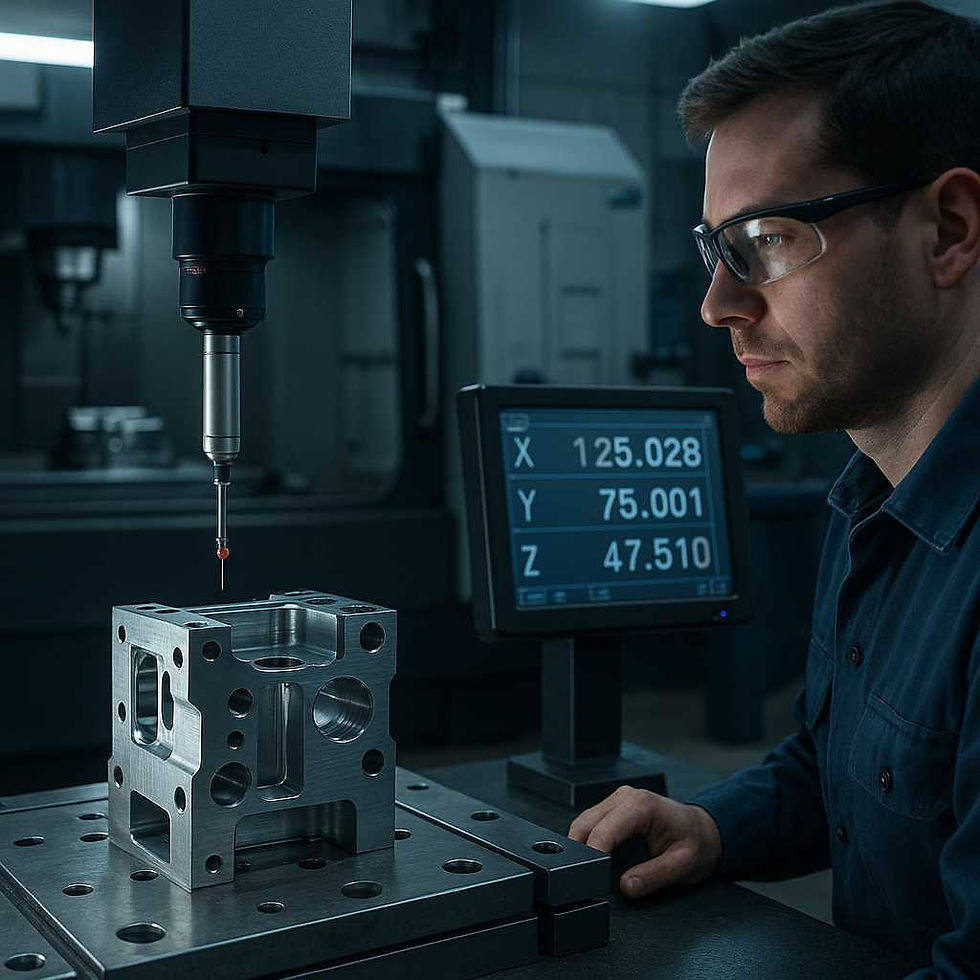
A coordinate measuring machine is the only practical tool for verifying complex GD&T callouts on production parts. A surface plate and height gauge can verify parallelism and flatness on simple geometry. But true position of a hole pattern to a 3-datum reference frame, or profile of a surface on a contoured part, requires a CMM with the correct measurement strategy programmed into it.
CMM programming for GD&T inspection starts with the datum reference frame. The CMM program must establish the datum planes in the correct priority order before measuring any controlled features. If the program establishes datums in the wrong order or uses a best-fit alignment instead of a constrained datum alignment, the reported deviations will not match what the print requires.
SCPM's MetroLab division handles CMM programming for both production inspection and first article inspection. The CMM reports generated by MetroLab report each GD&T characteristic individually, with the measured value, the tolerance, and the deviation, exactly as required for PPAP submission. A dimensional report that lists only measured sizes without GD&T context will not satisfy an automotive or aerospace customer's quality documentation requirement.
A2LA accreditation, which SCPM holds, requires that measurement processes meet defined uncertainty requirements. For GD&T measurements, that means the CMM uncertainty must be small enough relative to the tolerance being verified that the measurement result is meaningful. The commonly applied guideline is a 4-to-1 or 10-to-1 test uncertainty ratio. For a 0.001-inch position tolerance, the CMM system uncertainty must be 0.00025 inches or better to meet the 4-to-1 ratio.
Common GD&T Mistakes That Cause Rejected Parts
The most expensive GD&T mistakes happen at the print-reading stage, not at the machine. Once the setup is wrong, every part produced in that run is wrong.
Ignoring Material Condition Modifiers
The maximum material condition modifier (circle-M) on a position callout allows bonus tolerance as the feature departs from its maximum material condition. Ignoring this modifier means rejecting parts that are actually functional. A hole produced at the small end of its size tolerance is at MMC and receives no bonus tolerance. The same hole produced at the large end of its size tolerance receives bonus tolerance equal to the size departure. Missing this calculation has caused shops to reject functional parts that should have passed.
Using the Wrong Datum Reference for the Operation
A print may call out Datum A as a milled face, Datum B as a bored hole, and Datum C as a second bored hole. If the machinist sets up the part using a convenient face that is not Datum A, every position result measured from that setup is invalid, regardless of what the CMM printout says.
Applying Parallelism Instead of Profile
Parallelism controls only the orientation of a surface relative to a datum. It does not control the surface's location or form. On a flat mating surface that must be both parallel to its mating face and within a thickness dimension, parallelism alone is insufficient. Profile of a surface to the full datum reference frame is the correct callout. A common mistake is applying parallelism and assuming it covers the location requirement. It does not.
Confusing Concentricity with Runout
Concentricity requires verifying the derived median points of the entire feature, which is extremely difficult to measure reliably. Total runout measures the surface directly and is far more practical. When a print specifies concentricity on a production turned feature, it is worth raising the question with the customer about whether total runout at the same tolerance value serves the same functional intent. In most cases it does, and the substitution makes inspection straightforward.
Frequently Asked Questions
What does GD&T stand for and which standard governs it?
GD&T stands for geometric dimensioning and tolerancing. In North America, it is governed by ASME Y14.5-2018, published by the American Society of Mechanical Engineers. The equivalent international standard is ISO 1101, though there are meaningful differences between the two that matter when machining parts for global supply chains.
How tight a tolerance can a CNC machining center hold for a GD&T position callout?
A well-maintained CNC machining center with proper fixturing and tooling can reliably hold a true position of 0.001 to 0.002 inches on bored holes in aluminum. For steel and harder materials with tight positional requirements below 0.001 inches, additional operations such as jig boring, honing, or wire EDM may be required. The achievable tolerance depends on the part material, feature size, depth-to-diameter ratio, and the thermal stability of the machine during the run.
What is bonus tolerance and when does it apply?
Bonus tolerance applies when a position or other location callout carries a maximum material condition or least material condition modifier. As a feature of size departs from its maximum material condition, the stated position tolerance increases by the same amount as the size departure. For example, a hole with a diameter tolerance of 0.500 to 0.505 inches and a position tolerance of 0.010 inches at MMC receives 0.001 inches of bonus tolerance for every 0.001 inches the actual hole size exceeds 0.500 inches. A hole produced at 0.503 inches has a total allowable position of 0.013 inches.
Do I need a CMM to inspect GD&T callouts?
Not always, but for most production precision machining applications the answer is yes. Simple form callouts such as flatness on a machined face can be verified with a surface plate and dial indicator. However, true position of a hole pattern referenced to a 3-datum frame, profile of a surface on a contoured feature, or total runout on a stepped shaft all require CMM-level measurement to produce reliable, repeatable results that stand up to a customer's incoming inspection.
How does GD&T relate to PPAP documentation requirements?
PPAP, the Production Part Approval Process used in automotive supply chains, requires dimensional results for all characteristics shown on the part drawing and the control plan. For any drawing that uses GD&T, the dimensional report must list each GD&T characteristic with its actual measured value, the tolerance, and the deviation. A report that only lists nominal dimensions and measured sizes without addressing position, flatness, or profile callouts will not satisfy a PPAP Level 3 submission and will result in the submission being rejected by the customer's quality team.
What is the difference between profile of a surface and profile of a line?
Profile of a surface applies the tolerance band to the entire surface in three dimensions. Profile of a line applies the same band to individual cross-sectional slices of the surface, one slice at a time. Profile of a surface is more restrictive and more common for controlled surfaces such as mold cores, turbine blades, or complex brackets where the overall surface integrity matters. Profile of a line is used when the surface can vary between cross sections but each individual section must be controlled independently.
If you work with precision machined parts regularly, we want to hear which GD&T callouts create the most friction between your engineering and machining teams. Share your experience in the comments below.
References
ASME official site covering the Y14.5 geometric dimensioning and tolerancing standard
NIST resources on measurement uncertainty and dimensional metrology for manufactured parts
SME (Society of Manufacturing Engineers) technical resources on precision machining and tolerancing
AIAG resources on PPAP documentation requirements and automotive quality standards


Comments