
Cleanroom Rental Fort Wayne: When Manufacturers Need One
- carystraley
- 1 day ago
- 11 min read
Most manufacturers in Fort Wayne never think about cleanroom access until a contamination-sensitive project lands on their desk and they realize their standard shop floor is completely unsuitable. Particulates, humidity swings, and ambient shop debris can ruin precision assemblies, invalidate calibration work, and create rejected lots before the first shipment ever leaves the dock. Cleanroom rental in Fort Wayne solves a specific, costly problem for manufacturers who need controlled environment conditions without the capital expense of building their own ISO-classified space. This article explains exactly when you need one, what to look for, and how SCPM's MetroLab cleanroom fits into a real production workflow.
Table of Contents
Quick Takeaways
Key Insight
Explanation
Cleanroom rental avoids six-figure capital costs
Building an ISO Class 7 cleanroom in-house typically starts at $200 per square foot before HVAC, filtration, and certification. Rental gives you access on a per-project or monthly basis.
Not every precision job needs a cleanroom
Standard CNC machining tolerances under 0.001" do not automatically require a cleanroom. The trigger is contamination sensitivity of the end assembly, not dimensional tolerance alone.
ISO classification must match your customer's spec
Using an ISO Class 8 room when your customer requires ISO Class 7 is a compliance failure. Confirm the classification in your PPAP documentation before booking space.
Fort Wayne manufacturers often need cleanroom access for calibration support
Gauge calibration, CMM work, and first article inspection are all more accurate in a temperature- and humidity-controlled space. SCPM's MetroLab integrates both functions.
Controlled environment machining reduces scrap rates on tight assemblies
In practice, particulate contamination during assembly of hydraulic, pneumatic, or optical components is a leading cause of functional failures. A cleanroom eliminates this variable.
A2LA accreditation matters when your cleanroom work supports documentation
If calibration or inspection performed inside the cleanroom feeds into customer-facing reports, the accreditation status of the facility directly affects the validity of that documentation.
Cleanroom rental in Indiana is limited outside of Fort Wayne
Most general machine shops in Indiana do not maintain cleanroom space. Manufacturers in the region typically travel to Fort Wayne or Indianapolis, making local access a genuine competitive advantage.
What Is a Cleanroom and Who Actually Needs One
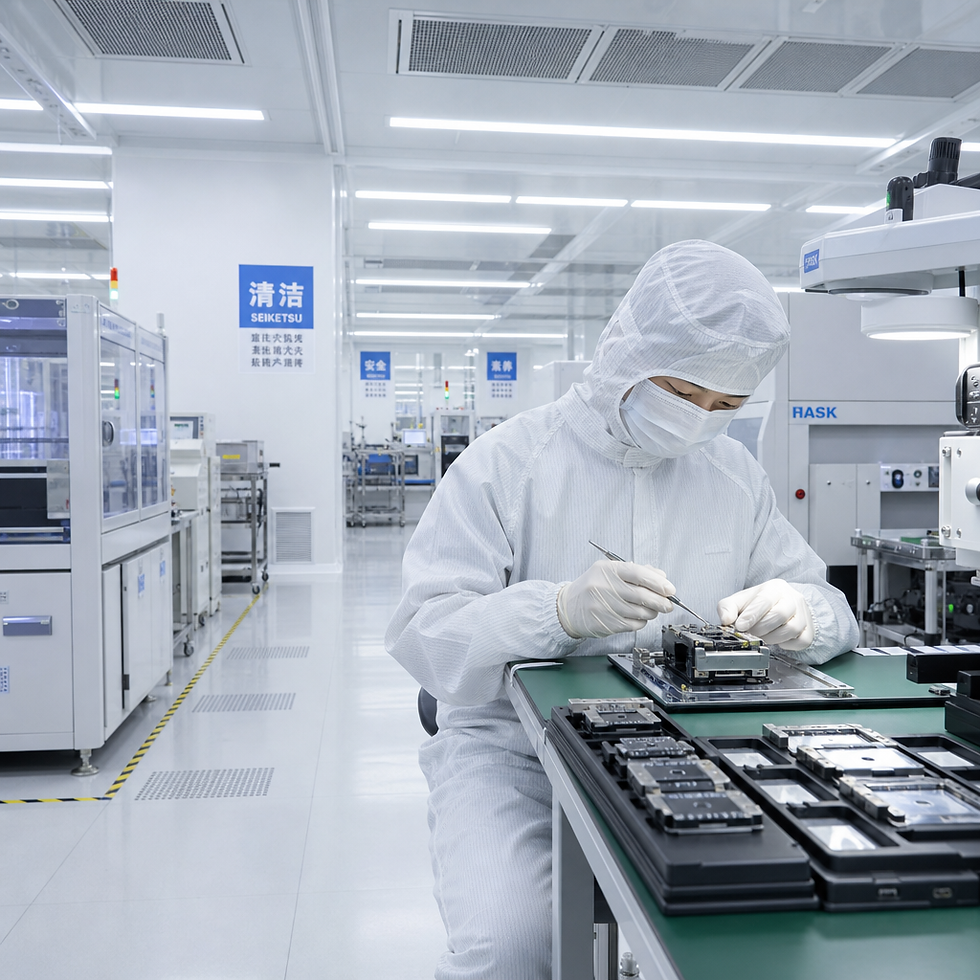
A cleanroom is a controlled manufacturing or inspection environment where airborne particulate contamination, temperature, humidity, and pressure are regulated to defined standards. The ISO 14644 standard is the governing document for most industrial cleanrooms, and it classifies rooms from ISO Class 1 (nearly particle-free) to ISO Class 9 (ordinary room air with minimal filtration). For most cleanroom manufacturing in Indiana, ISO Class 7 and ISO Class 8 are the practical working range.
The manufacturers who genuinely need cleanroom access share a common characteristic: their components or assemblies fail not because of dimensional error but because of contamination introduced during handling, inspection, or final assembly. This includes producers of hydraulic valve bodies, fuel system components, optical assemblies, medical device subcomponents, and precision sensors. If a single 10-micron particle lodged in a port or seating surface can cause a warranty return, you need controlled environment conditions.
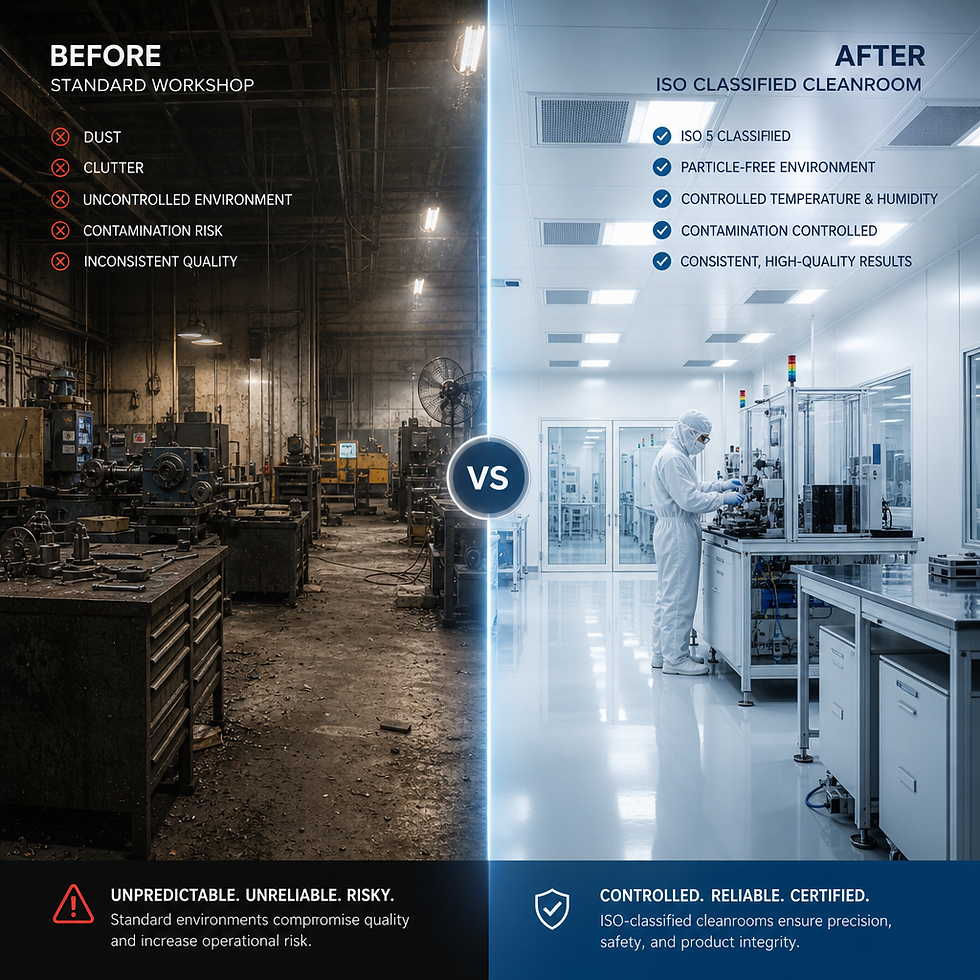
A common mistake is assuming that any shop with good housekeeping practices can substitute for a certified cleanroom. That is not accurate. A well-swept machine shop floor still carries particulate counts orders of magnitude higher than even a basic ISO Class 8 space. The difference is not about cleanliness habits. It is about engineered air change rates, HEPA filtration, positive pressure differentials, and gowning protocol enforcement.
ISO Classifications: What the Numbers Mean for Manufacturers
ISO 14644-1 defines cleanroom classes by the maximum allowable concentration of airborne particles at specified sizes. ISO Class 7 allows a maximum of 352,000 particles per cubic meter at 0.5 microns and larger. ISO Class 8 allows up to 3,520,000 particles at the same threshold. The practical difference is real and significant for assembly work involving tight clearances.
ISO Class 7 Applications for Precision Manufacturers
ISO Class 7 is the standard most frequently cited in aerospace and automotive tier-1 supplier contracts where contamination control is a documented requirement. If your customer is submitting a PPAP package that includes contamination control as a control plan element, they are almost certainly specifying ISO Class 7 or better. This class requires roughly 60 air changes per hour and HEPA filtration at the supply air level.
ISO Class 8 Applications and Common Misconceptions
ISO Class 8 is appropriate for assembly work where cleanliness matters but the contamination threshold is higher, such as general precision mechanical assembly, gauge handling, and component staging prior to final assembly. Many manufacturers assume Class 8 is adequate for everything short of semiconductor work. In practice, if your end-use environment involves fuel, hydraulic fluid, or a sealed pneumatic system, you should be discussing Class 7 with your quality team.
"Contamination control is not a late-stage quality check. It is a process design decision that must be made before the first component enters the assembly area." - ISO 14644-4, Design, Construction and Start-Up Guidance
Temperature control inside a cleanroom also matters for inspection accuracy. CMM measurements and gauge calibration are calibrated at 68 degrees Fahrenheit (20 degrees Celsius) per ASME B89 standards. A cleanroom that maintains this temperature removes thermal expansion as a measurement error source, which is precisely why SCPM's MetroLab cleanroom is designed to support both assembly and inspection functions in the same controlled environment.
When Controlled Environment Machining Is Non-Negotiable
Controlled environment machining becomes non-negotiable in four specific situations that are common among Fort Wayne-area industrial manufacturers. Recognizing these situations before the project starts, rather than after a quality escape, is the difference between a profitable contract and an expensive lesson.
Hydraulic and Pneumatic Component Assembly
Hydraulic and pneumatic systems fail at clearances measured in microns. A single metal chip or fiber contaminating a servo valve spool can cause erratic control behavior or complete failure in service. Assembly of these components must occur in a controlled environment. This is not a recommendation. It is written into cleanliness standards like ISO 4406 for hydraulic fluid cleanliness and SAE AS4059 for aerospace hydraulic systems.
First Article Inspection and PPAP Documentation
When a customer requires first article inspection (FAI) with dimensional data that will be submitted as part of a PPAP package, the measurement environment affects the validity of every data point. Thermal gradients from an open shop floor introduce systematic error in CMM results. SCPM performs CMM programming and first article inspection inside their MetroLab cleanroom specifically to eliminate this variable from the measurement chain.
Optical and Electronic Subcomponent Assembly
Sensors, encoders, and optical subassemblies are sensitive to particulate contamination in ways that mechanical components are not. A dust particle on a lens surface or an encoder strip introduces functional errors that have no visible defect at the time of assembly. These assemblies must be built and inspected in a classified cleanroom environment.
Calibration and Gauge Manufacturing Support
Gauge manufacturing at tight tolerances requires that the gauges themselves be calibrated and verified in a stable temperature and humidity environment. SCPM's MetroLab division provides calibration support within their controlled environment, which means gauge blocks, go/no-go gauges, and custom fixtures receive traceability documentation that holds up to A2LA accreditation requirements.

Cleanroom Rental vs. Building Your Own: The Real Cost Comparison
The decision to rent versus build is not complicated once you put real numbers on the table. The data consistently shows that building a cleanroom is only economically justified when you have continuous, full-time demand for the space across multiple years and the capital to absorb initial construction costs without disrupting operations.
Factor
Cleanroom Rental (SCPM MetroLab)
Building Your Own ISO Class 7 Cleanroom
Upfront capital cost
None
$150,000 to $500,000+ depending on size and specification
Time to access
Days to schedule
6 to 18 months for construction and certification
Accreditation status
A2LA accredited facility already in place
Requires separate accreditation process costing $5,000 to $20,000+
Ongoing maintenance cost
Included in rental agreement
$15,000 to $60,000 per year for HVAC maintenance, filter replacement, particle monitoring
Flexibility
Use when you need it, scale down when you do not
Fixed overhead regardless of utilization
Integrated inspection support
CMM, calibration, and PPAP documentation available in the same facility
Must source separately unless you build the full capability stack
For manufacturers in Fort Wayne who have one to three projects per year requiring controlled environment conditions, rental is the clear economic choice. Even for higher-volume shops, rental eliminates the risk of owning cleanroom infrastructure during periods of reduced production demand.
Pro tip: Before you budget for a cleanroom build, calculate your actual utilization hours per year. If your controlled environment need is under 1,000 hours annually, rental will cost less than the annual maintenance expense of an owned facility at comparable specification.
What to Look For in a Cleanroom Rental in Fort Wayne
Not all cleanroom rental options are equivalent, and the differences matter when your work product must carry customer-facing quality documentation. There are five things worth evaluating before you commit to any rental arrangement in the Fort Wayne and northern Indiana market.
Confirmed ISO Classification with Particle Count Testing
Ask for the most recent particle count certification data for the room. A facility claiming to be ISO Class 7 should have documentation from an accredited testing lab confirming particle counts at 0.5 microns and 5 microns. If they cannot produce it, walk away. The classification is meaningless without the test data to back it.
Temperature and Humidity Stability Records
For any cleanroom rental that will support measurement, inspection, or calibration work, temperature stability matters as much as particulate count. The room should maintain 68 degrees Fahrenheit plus or minus 2 degrees with humidity controlled to prevent condensation and dimensional changes in metal components. Ask for monitoring logs, not just a specification sheet.
Integrated Quality Services
A cleanroom that sits in isolation from inspection equipment forces you to move parts back into an uncontrolled environment the moment you need to verify a dimension. The most useful cleanroom rental arrangements for precision manufacturers include access to CMM equipment, calibration instruments, and the technical staff to run them. SCPM's MetroLab cleanroom is built specifically around this integrated model, which is why it serves Fort Wayne manufacturers differently than a generic cleanroom rental space would.
A2LA Accreditation and Documentation Support
If the work you perform inside the cleanroom will generate inspection reports, calibration certificates, or PPAP documentation that goes to a customer or regulatory body, the accreditation status of the facility affects the credibility of those documents. A2LA accreditation means the facility's measurement and calibration processes have been independently audited for conformance to ISO 17025. SCPM holds A2LA accreditation through its MetroLab division, which means reports generated there carry the weight customers expect from a documented quality management system.
Pro tip: When evaluating cleanroom rental options, ask specifically whether the facility's accreditation scope covers the measurements you need. A2LA accreditation is scope-specific. A facility accredited for dimensional measurement may not be accredited for torque calibration. Confirm the scope matches your project before scheduling.
How SCPM's MetroLab Cleanroom Supports Production Workflows
Summit City Precision Machining's MetroLab cleanroom rental in Fort Wayne is purpose-built for the type of work that precision manufacturers in the automotive, aerospace, and industrial sectors actually bring through the door. It is not a repurposed storage room with a HEPA filter bolted to the ceiling. It is a certified, staffed, accredited environment that connects directly to SCPM's broader capabilities in 5-axis CNC milling, wire EDM, lathe machining, and CMM programming.
In practice, this means a manufacturer can bring a complex assembly project to SCPM, have the machined components produced on the production floor, move them through the cleanroom for contamination-controlled assembly or inspection, and receive a completed PPAP package without sourcing three different vendors for machining, inspection, and cleanroom access. That consolidation matters enormously for turnaround time and documentation traceability.
The MetroLab cleanroom is also available for third-party use. If you have your own machined components produced elsewhere and need a controlled environment for assembly, inspection, or calibration in Fort Wayne, you can rent access to the space and the associated inspection equipment without committing to full-service machining. This flexibility makes it a practical option for contract manufacturers across northern Indiana who periodically need ISO-classified space without justifying their own buildout.
SCPM's fixturing services also integrate with cleanroom workflows. Custom fixtures developed for controlled environment assembly or inspection can be designed, fabricated, and qualified by the same team that operates the cleanroom, eliminating the translation errors that occur when fixtures are built by one vendor and used in another facility's quality system.
Frequently Asked Questions
What ISO classification does SCPM's MetroLab cleanroom maintain?
SCPM's MetroLab cleanroom is designed to support precision inspection and calibration work consistent with the temperature, humidity, and particulate control requirements of ISO 14644. For specific classification data and current particle count documentation, contact SCPM directly at goscpm.com, as room specifications are confirmed based on current certification testing cycles.
Can I rent the cleanroom for just one day or one project?
Yes. Cleanroom rental through SCPM's MetroLab is available on a project or scheduled access basis, not exclusively on long-term contracts. This makes it practical for manufacturers who have occasional contamination-sensitive work without ongoing volume that would justify a monthly arrangement.
Does cleanroom rental include access to CMM or calibration equipment?
SCPM's MetroLab integrates calibration support and CMM programming capabilities with the cleanroom environment. Access to specific equipment is confirmed during project scoping. The integrated model is specifically designed so that manufacturers do not have to move components out of a controlled environment to perform inspection or measurement.
What is the difference between cleanroom manufacturing and standard precision machining?
Standard precision CNC machining is performed on a shop floor where ambient particulate counts, temperature variation, and coolant mist are present and managed for machining quality but not for contamination-sensitive assembly. Cleanroom manufacturing introduces the machined components into an ISO-classified environment for assembly, inspection, or final handling steps that cannot tolerate particulate contamination. The machining itself is typically done outside the cleanroom. The cleanroom governs what happens after machining is complete.
Why does temperature control inside a cleanroom matter for measurement accuracy?
All dimensional measurement is traceable to a reference temperature of 20 degrees Celsius (68 degrees Fahrenheit) per ASME B89 and ISO 1 standards. Metal components expand and contract with temperature at known rates. A 10-degree temperature difference in the measurement environment introduces measurable dimensional error on tight-tolerance components. Cleanrooms that maintain stable temperature remove this error source from CMM and gauge measurement results, which is why calibration and first article inspection performed in a controlled environment produces more defensible data than the same work done on an open shop floor.
Who in Fort Wayne or northern Indiana typically uses cleanroom rental services?
The primary users of cleanroom rental in Fort Wayne are contract manufacturers producing components for automotive tier-1 and tier-2 suppliers, aerospace subcontractors, medical device assemblers, and industrial equipment producers working with hydraulic or pneumatic systems. Calibration labs and quality service providers who need access to controlled measurement space without building their own facility are also common users of SCPM's MetroLab cleanroom.
Is A2LA accreditation required for all cleanroom work?
A2LA accreditation is not universally required for all cleanroom work, but it is required when the output of that work is a calibration certificate, inspection report, or measurement record that must meet ISO 17025 requirements. Many automotive customers and aerospace prime contractors require that calibration and inspection documentation be traceable to an accredited laboratory. If your customer's purchase order or quality requirements reference ISO 17025 or A2LA, the accreditation status of the facility you use is a compliance requirement, not an optional preference.
Have you worked through a cleanroom rental arrangement for a precision manufacturing project in Indiana? Share what worked, what surprised you, or what you would do differently in a future project.


Comments