
Cleanroom Machining: What Industrial Buyers Must Know
A single particle of cutting fluid residue, a microscopic metallic chip, or an airborne fiber can destroy the functionality of a precision component in a contamination-sensitive application. For industrial buyers sourcing machined parts for aerospace assemblies, medical devices, optical systems, or semiconductor equipment, the question is not just whether a supplier can hold tight tolerances. It is whether they understand cleanroom machining well enough to protect part integrity from the moment machining ends through packaging, shipping, and delivery. Most shops do not. Knowing what separates a capable supplier from an inadequate one can prevent expensive failures downstream.
Table of Contents
What Cleanroom Machining Actually Means
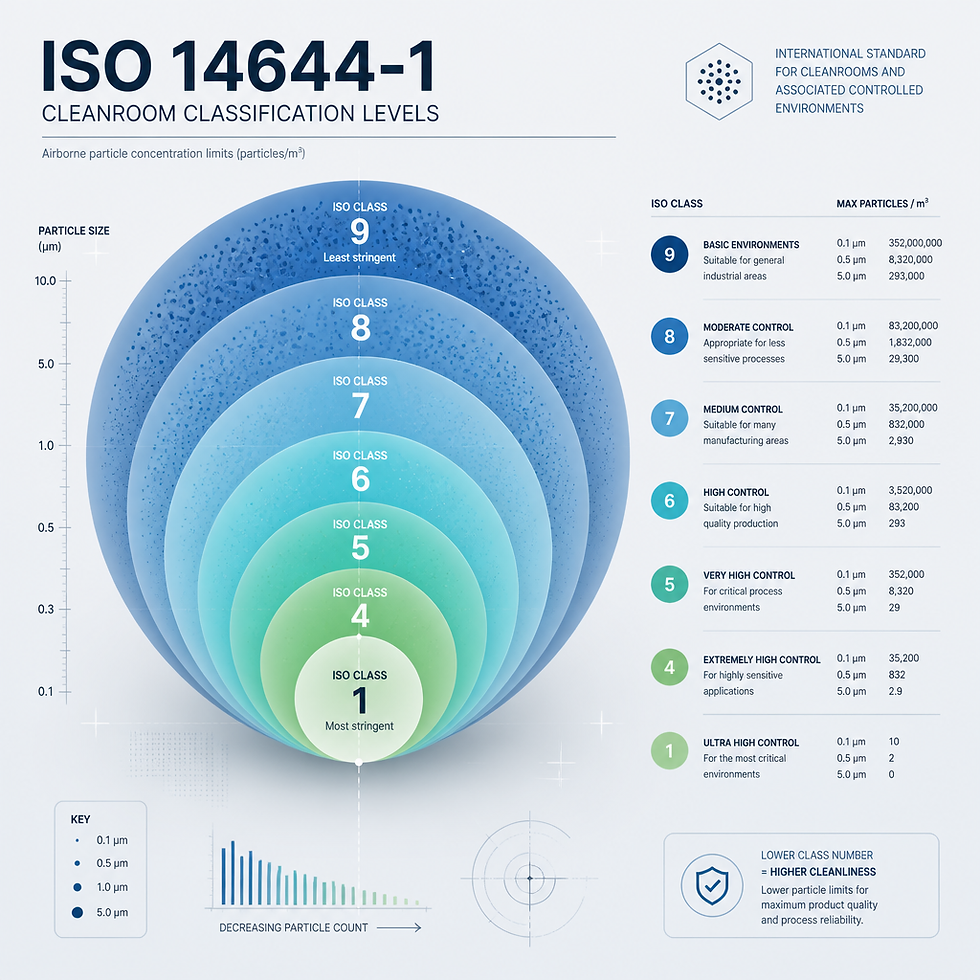
Cleanroom machining is the production of precision components in a controlled environment where airborne particles, temperature, humidity, and contamination sources are regulated according to defined standards. The governing standard is ISO 14644, which classifies environments from ISO Class 1 (the most stringent) through ISO Class 9 (least controlled). Most industrial machining applications for contamination-sensitive components operate in the ISO Class 7 or ISO Class 8 range.
The phrase is frequently misused. Many suppliers claim cleanroom capability when what they actually offer is a tidy shop floor and nitrile gloves. Real cleanroom machining involves a certified, validated environment with documented air change rates, HEPA or ULPA filtration, positive pressure differentials, gowning protocols, and controlled access. That is a materially different thing from good housekeeping.
There is also an important distinction between machining inside a cleanroom and cleanroom-compatible handling after conventional machining. Not every contamination-sensitive component needs to be cut inside a classified environment. What matters is whether contamination can be reliably eliminated before the part reaches its final, sealed state. A supplier who understands that distinction will give you better guidance than one who defaults to a single answer for every job.
ISO Classifications and What They Require
ISO 14644-1 defines cleanroom classifications based on the maximum permissible concentration of airborne particles per cubic meter at specific particle sizes. The class number directly corresponds to the cleanliness level, with lower numbers indicating stricter environments. Understanding these classes is necessary for specifying what you actually need, rather than over- or under-buying cleanliness.
For most precision manufacturing applications involving contamination-sensitive components, the relevant classes are:
ISO Class 5: Used for applications with extremely tight particle limits, such as semiconductor wafer processing and some optical assembly work. Air changes are very high, and the environment is expensive to build and operate.
ISO Class 7: Common for medical device assembly, aerospace component preparation, and high-precision optical work. Limits airborne particles to 352,000 per cubic meter at 0.5 microns or larger. Typically requires 30 to 60 air changes per hour.
ISO Class 8: Suitable for many industrial precision parts where contamination control is important but extreme sterility is not required. Still significantly cleaner than a standard machine shop environment.
A buyer who simply asks for a "cleanroom part" without specifying the ISO class, the cleanliness level of the finished part surface, and the required packaging protocol has not actually specified the job. ISO 14644 classifies the environment only. It does not prescribe surface roughness, acceptable residual contamination on the part, cleaning methods, or packaging standards. Those are separate requirements that must be stated explicitly in your print or purchase order.
ISO 14644 classifies the air in the room. It does not certify the cleanliness of the part that comes out of it. Buyers who conflate the two consistently receive parts that fail incoming inspection.
Quick Takeaways
Key Insight
Explanation
ISO class defines the environment, not the part
ISO 14644 classifies airborne particles in the room. Finished-part cleanliness must be specified separately through surface cleanliness standards or customer-defined acceptance criteria.
Not all contamination-sensitive parts need in-cleanroom machining
Many parts can be conventionally machined, then cleaned, inspected, and packaged under controlled conditions. In-cleanroom machining is needed only when post-machining cleaning cannot reliably reach critical surfaces.
Packaging is part of the contamination control chain
A correctly machined and cleaned part that is bagged in standard shop packaging can arrive contaminated. Double-bagging, nitrogen purging, and cleanroom-compatible packaging materials are non-negotiable for many applications.
Supplier documentation matters as much as capability
For aerospace and medical applications, you need traceability records, cleaning validation records, and certificate of conformance tied to lot or serial number. Verbal assurances are not acceptable.
Tooling and fixturing can introduce contamination
Cutting tools coated with standard shop lubricants, fixtures with oil-soaked surfaces, and workholding devices that transfer particulate all represent contamination pathways that a qualified supplier controls.
Accreditation signals process discipline, not just equipment
A2LA accreditation or ISO 13485 registration requires documented, audited processes. These are stronger quality indicators than a shop simply owning cleanroom equipment.
First article inspection in a controlled environment catches contamination failures early
Running a first article through the full cleanroom handling and packaging process before production release surfaces contamination-related process gaps before they affect an entire production run.
When Does Machining Need to Happen Inside a Cleanroom
The decision to machine a part inside a classified cleanroom versus machine it conventionally and then clean and package it in a controlled environment is an engineering judgment, not a reflexive upgrade. Getting this decision wrong in either direction costs money: over-specifying it drives up costs unnecessarily, and under-specifying it produces field failures.
Machining must occur inside a classified cleanroom when a critical surface cannot be reliably cleaned after the fact. This is most common when part geometry creates internal features, blind holes, or complex channels that traps particulate and cutting fluid in ways that cleaning processes cannot reach consistently. It is also required when the material itself is sensitive to the cleaning chemistries that would otherwise be used, or when bioburden limits are strict enough that any post-machining environmental exposure is unacceptable.
For the majority of precision industrial components, however, conventional CNC machining followed by a validated cleaning sequence, controlled inspection, and clean packaging is the correct approach. This is particularly true for components destined for cleanroom equipment housings, fixturing, and structural elements where the part never directly contacts a process-sensitive surface.
Pro tip: Before specifying in-cleanroom machining, ask your design team whether the critical surfaces can be accessed and verified clean after a post-machining cleaning process. If yes, you can likely achieve the required cleanliness without the cost premium of in-cleanroom cutting.
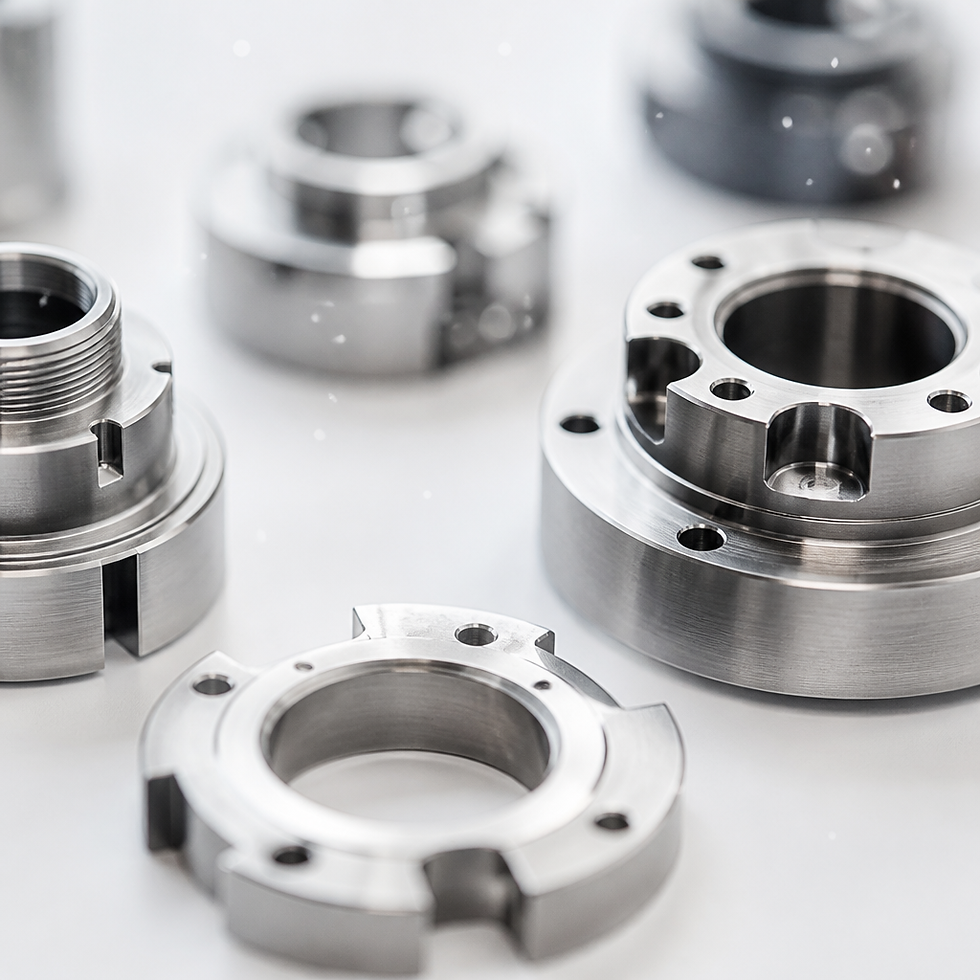

Contamination-Sensitive Components by Industry
Contamination risks and the appropriate responses to them vary significantly across industries. A buyer in aerospace has a different contamination threat model than one in semiconductor equipment manufacturing, even if both are ordering precision machined aluminum components.
Aerospace and Defense
Aerospace applications must account for both particulate and molecular contamination. Hydrocarbon residues from cutting fluids can interfere with bonding processes, sensor performance, and optical surfaces. ASTM E2217 provides specific guidance for aerospace cleanroom design and contamination-controlled fabrication areas, including requirements around extended hardware exposure durations and molecular contamination sensitivity. For aerospace buyers, asking a supplier whether they understand molecular contamination (not just particulate) is a meaningful qualification question.
Medical Device and Surgical Instrument Manufacturing
Medical components face both particle contamination and bioburden requirements. Microbiological contamination can compromise the sterility and safety of implants and surgical instruments. Suppliers serving medical customers should hold ISO 13485 registration and be able to provide documented cleaning and packaging validation. An A2LA accredited metrology capability is also valuable when inspection is part of the contamination-sensitive workflow.
Semiconductor and Electronics Equipment
Dust, oils, and moisture residues on components for semiconductor equipment can cause short circuits or premature corrosion. These applications frequently require ISO Class 5 or 7 environments and strict controls over ionic contamination and particle size distribution. Suppliers who serve this market need robust traceability systems because a contamination event traced back to a machined component is an expensive, high-visibility failure.
Industrial Precision and Cleanroom Equipment
Precision housings, frames, fixturing components, and automation hardware destined for cleanroom environments in any industry must be machined and packaged in ways that do not introduce contamination into the customer's controlled environment. Even if the part itself is not a process-critical element, bringing it into a cleanroom in standard shop packaging defeats the purpose. This is an area where many otherwise competent machine shops fail their customers.
What to Demand from a Precision Manufacturing Services Supplier
When evaluating a precision manufacturing services supplier for contamination-sensitive work, the checklist goes well beyond quoting tolerance capability and material certifications. You are evaluating a complete contamination control chain, from raw material handling through final packaging and shipment.
Certified and Validated Environment
Ask for the ISO 14644 certification documentation for the cleanroom, including the most recent particle count certification date. A cleanroom that has not been recertified on a documented schedule is no longer a controlled environment by definition. Ask specifically what the air change rate is, what the filtration type is, and how gowning is enforced.
Cleaning Process Documentation
For contamination-sensitive components, the cleaning process must be documented and validated, not improvised. A qualified supplier will have a written cleaning procedure that specifies cleaning agents, ultrasonic cleaning parameters if used, rinse sequences, drying methods, and inspection criteria. Ask to see the procedure, not just a statement that cleaning is performed.
Inspection and Traceability
CMM programming and first article inspection capability is not just about dimensional conformance. For contamination-sensitive work, inspection must include visual and surface cleanliness verification, and the results must be traceable to the specific lot or serial number of components. Suppliers with in-house CMM capabilities and documented PPAP processes are better positioned to provide this level of traceability.
Cleanroom-Compatible Packaging
Packaging is where many otherwise capable suppliers fail. Cleanroom-compatible packaging means low-outgassing bags, appropriate double-bagging or heat-sealed pouches, anti-static materials where required, and labels that do not shed particulate. The packaging step must happen inside the controlled environment, not on a standard shop bench after the parts have been moved across a shop floor.
Pro tip: When visiting a potential supplier, ask to watch the transition from machining to final packaging for a contamination-sensitive part. How the team handles parts between operations tells you more about their contamination discipline than any quality certificate on the wall.
Comparison of Contamination Control Approaches
Industrial buyers sourcing contamination-sensitive machined components typically encounter three distinct approaches from suppliers. Understanding the real differences between them helps you match the approach to the actual risk level of your application rather than defaulting to the most expensive option or, worse, accepting the cheapest one without question.
Approach
Best Fit Applications
Limitations and Risks
Conventional machining with validated post-process cleaning and clean packaging
Most industrial precision components, cleanroom equipment housings, fixturing, structural elements where critical surfaces are accessible for cleaning verification
Requires documented, validated cleaning process. Fails if part geometry traps contamination that cleaning cannot reach. Inadequate for tight bioburden or molecular contamination limits.
In-cleanroom CNC machining (ISO Class 7 or 8 environment)
Components with critical surfaces that cannot be cleaned after machining, high-value parts with strict particulate or bioburden limits, medical implant-related components, optical surfaces
Higher cost per part. Requires certified cleanroom infrastructure and trained personnel. Not necessary for most industrial precision components and is frequently over-specified.
Cleanroom rental and controlled environment assembly
Low-volume or prototype work, customers who need access to a certified cleanroom environment for their own assembly or packaging but cannot justify owning one
Requires the customer to understand cleanroom protocols. Supplier must ensure the space is certified, gowning is enforced, and the environment is maintained between uses. Best for buyers with specific short-run needs.
Common Mistakes Industrial Buyers Make
After years of working with industrial buyers on contamination-sensitive machined components, certain purchasing mistakes come up repeatedly. They are worth naming directly because they are preventable.
Specifying ISO Class Without Specifying Part Cleanliness
Specifying "ISO Class 7" on a drawing or purchase order tells the supplier what kind of room to use. It does not tell them what the part surface must look like when it leaves. You need to specify part cleanliness separately, whether through a reference standard, a defined particle count per surface area, or explicit acceptance criteria on your print.
Accepting "We Have a Cleanroom" Without Verification
Many shops have a space they call a cleanroom that has never been certified to any ISO class. Ask for the certification documentation. If a supplier cannot produce a current particle count certification with a date and a classification number, their cleanroom claim is marketing, not quality assurance.
Ignoring the Chain of Custody Between Operations
A part that is machined in a controlled environment and then moved across a standard shop floor for secondary operations, deburring, or marking before re-entering the cleanroom for packaging has been contaminated. The entire handling chain from machining to final sealed packaging must be controlled. Asking specifically how secondary operations and inter-operation handling are managed is a critical qualification question.
Overlooking the Role of First Article Inspection
Running a first article inspection on the dimensional characteristics of a contamination-sensitive part is standard practice. Running that same first article through the complete cleaning, packaging, and documentation process before production release is less common, but it is the only way to validate the full workflow before committing to a production run. A supplier with strong CMM programming and PPAP documentation capabilities can build this into the first article plan without significant additional cost.
Choosing on Price Alone for High-Consequence Applications
For contamination-sensitive work, the cost of a supplier failure is almost never the part price. It is the downstream cost of field failures, rework, sterilization reprocessing, or regulatory response. Sourcing decisions based primarily on unit cost for this category of work routinely produce outcomes that are far more expensive than the premium a qualified supplier would have charged.
Frequently Asked Questions
What is the difference between ISO Class 7 and ISO Class 8 for machined components?
ISO Class 7 permits a maximum of 352,000 particles per cubic meter at 0.5 microns or larger, while ISO Class 8 allows up to 3,520,000 particles per cubic meter at the same size. ISO Class 7 is significantly more controlled and is typically required for medical device assembly, aerospace component preparation, and precision optical work. ISO Class 8 is appropriate for many industrial precision applications where contamination control is important but extreme sterility is not required. The correct class for your application depends on your part's contamination sensitivity, your customer's requirements, and any applicable regulatory or industry standards.
Do all precision machined parts for cleanroom equipment need to be machined in a cleanroom?
No. Many components destined for cleanroom equipment, including housings, frames, fixtures, and structural elements, can be conventionally machined and then cleaned, inspected, and packaged under controlled conditions. In-cleanroom machining is only necessary when a critical surface cannot be reliably cleaned after conventional machining, or when the part has strict particulate or bioburden limits that make any post-machining environmental exposure unacceptable. Specifying in-cleanroom machining for every part regardless of contamination risk drives up cost without improving outcomes.
How do I verify that a machined part actually meets my cleanliness requirements?
Verification methods depend on your cleanliness specification. Common approaches include visual inspection under appropriate lighting, black light inspection for hydrocarbon residues, particle extraction and counting using a defined surface area sample, and gravimetric cleanliness testing where particles collected from a rinse of the part are weighed against an acceptance limit. Whichever method you use, the procedure, acceptance criteria, and results must be documented and tied to the specific part lot or serial number. If your supplier cannot show you this documentation, your cleanliness requirement has not been verified.
What documentation should I require from a supplier for contamination-sensitive components?
At minimum, you should require a certificate of conformance tied to the specific lot or serial number, documentation of the cleaning process used, the ISO classification certification of the environment in which parts were handled or packaged, and records of any inspection steps performed. For regulated industries, you may also require material certifications, PPAP documentation, and first article inspection reports. If your application involves medical devices, the supplier should be operating under an ISO 13485 quality management system with documentation that can support your regulatory submission.
Can I rent cleanroom space at a machine shop rather than having my own facility?
Yes, and for buyers with short-run or prototype needs, cleanroom rental from a precision machining supplier is a practical option. It gives you access to a certified, maintained environment without the capital investment of building and operating your own. The key requirements are that the cleanroom must be currently certified to the ISO class you need, gowning and access protocols must be enforced, and the supplier must be able to confirm the environment's certification status and maintenance history. Verify those points before committing to a program.
How does A2LA accreditation relate to cleanroom machining capability?
A2LA accreditation is an independent third-party assessment of a laboratory's technical competence and quality management system. For precision manufacturing, it specifically validates measurement and inspection processes against documented, audited standards. When a supplier's metrology or inspection lab is A2LA accredited, it means their CMM programming, calibration processes, and measurement practices have been externally verified. For contamination-sensitive components where dimensional and surface inspection results must be defensible, an A2LA accredited inspection capability is a meaningful differentiator from a supplier whose inspection processes are self-assessed.
Have you encountered a contamination-related part failure that could have been prevented at the supplier level? Share what you learned in the comments, or reach out to discuss how your current sourcing approach addresses contamination control.
References
Cleanroom manufacturing ISO classifications and industrial applications explained
Cleanroom equipment machining parts: CNC process decisions and supplier selection guide
ASTM E2217 standard practice for aerospace cleanroom and contamination-controlled area design
ISO 14644-1 cleanroom classification guide with particle concentration limits by class


Comments